Is Cold Email Legal? Rules in the US, UK, EU, Canada and Australia
A cold email is a message sent to a person or company that has no prior relationship with the sender and did not ask to hear from them, usually one sales rep writing to one prospect about their job. Each law below protects recipients in its own territory, so a US sender writing to prospects in London, Lyon and Toronto should expect to meet four sets of rules.
This page summarises what each regulator or statute says, as read on 13 November 2026. It is not legal advice; ask a lawyer about your own campaign. The rules for bulk purchased lists are a separate question, covered in is buying email lists legal.
Is cold emailing illegal?
Cold emailing is not illegal in itself in any of the five places below, but only the United States has no consent requirement for any kind of recipient, and every country attaches conditions to the message.
| Country | Is consent needed for B2B cold email? | Key conditions | Source |
|---|---|---|---|
| United States | No. CAN-SPAM is an opt-out law. | Accurate headers and subject, a postal address, a working opt-out honoured within 10 business days. | FTC CAN-SPAM compliance guide |
| United Kingdom | No PECR consent for corporate subscribers. Yes for sole traders and some partnerships. | Identify yourself, offer an opt-out, and meet UK GDPR for any named person: a lawful basis and an absolute right to object. | ICO business-to-business marketing guidance |
| European Union | Varies by member state. | France, for example, allows B2B prospecting without prior consent if the person is informed, can object, and the subject relates to their profession. | CNIL guidance on email prospecting |
| Canada | Yes. Express or implied consent. | Implied consent can come from a conspicuously published work address when the message is relevant to the person's role. The sender must prove consent. | CASL, sections 6, 10 and 13 |
| Australia | Yes. The Spam Act 2003 bans unsolicited commercial electronic messages. | Consent, which the Act says may be inferred in some cases, accurate sender information and a functional unsubscribe facility. | Spam Act 2003, sections 16 to 18 and Schedule 2 |
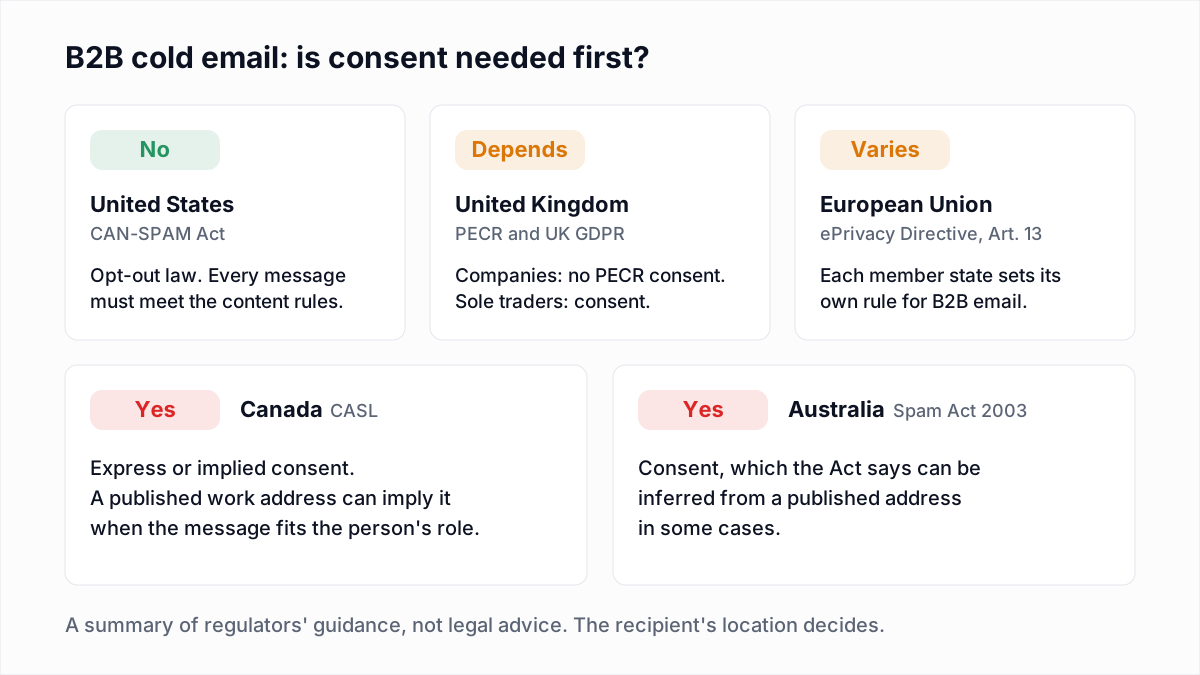
Is cold email legal in the United States?
Cold email is legal in the United States without prior consent, provided every message follows the CAN-SPAM Act. The FTC's CAN-SPAM compliance guide says the Act "covers all commercial messages" and that "the law makes no exception for business-to-business email". As read on 13 November 2026, the guide lists eight main requirements:
- Don't use false or misleading header information.
- Don't use deceptive subject lines.
- Identify the message as an ad.
- Tell recipients where you're located, with a "valid physical postal address". A registered post office box or private mailbox counts.
- Tell recipients how to opt out of future marketing email from you.
- Remember that subscribers and members can opt out of marketing emails, too.
- Honor opt-out requests promptly: the mechanism must work for at least 30 days after sending, and requests must be honoured within 10 business days, with no fee and nothing asked for beyond an email address.
- Monitor what others are doing on your behalf. The guide says "you can't contract away your legal responsibility", so an outreach agency's mistakes are also yours.
On penalties, the FTC guide states that "each separate email in violation of the CAN-SPAM Act is subject to penalties of up to $53,088". The page carries a note that it was edited in January 2024 to reflect inflation-adjusted civil penalty maximums, so check the page for the current figure.
Is B2B cold email legal in the UK?
B2B cold email is legal in the UK without consent when the recipient is a corporate subscriber, such as a limited company, but needs consent when the recipient is a sole trader or one of some kinds of partnership. Two laws apply at once: PECR governs the sending, and UK GDPR governs the personal data.
The ICO's business-to-business marketing guidance says "the PECR rule on direct marketing by electronic mail does not apply to corporate subscribers", defined as "a corporate body with separate legal status". Sole traders and other types of partnerships are classed as individual subscribers, and the ICO says you can only email them if they "have specifically consented, or the 'soft opt-in' applies". The soft opt-in is for your own customers, so it does not help with cold prospects.
Emailing a corporate subscriber still carries three duties in the same guidance:
- Identify yourself and offer an opt-out. You must not disguise or conceal your identity, and you must give a valid address for opting out.
- Have a lawful basis. An address such as firstname.lastname@company "will constitute personal data even if they are acting in their business capacity". The ICO points to legitimate interests but says "there is no absolute rule and you need to apply the legitimate interests three-part test".
- Stop when asked. The right to object to direct marketing "is absolute and there are no grounds for you to refuse". The ICO recommends a "do not email" list rather than deleting the record; see how a suppression list works.
The ICO page notes that this guidance "is under review and may be subject to change". The practical problem is that a list rarely tells you whether "Smith Plumbing" is a company or a sole trader, so check before you send.
Is cold email legal in the EU under GDPR?
Cold email in the EU is governed by each member state's own law implementing Article 13 of the ePrivacy Directive, so the answer for business contacts depends on the country, while consumers need prior consent. GDPR applies on top wherever the address identifies a person, which is why regulators talk about informing people and letting them object.
One regulator shows how the national layer works. France's CNIL, in its guidance on commercial prospecting by email (page dated 10 June 2026), says prospecting to consumers is allowed only if they consented beforehand. For professionals the CNIL does not require prior consent: the person must be informed and able to object, and the subject of the message must relate to their profession. Generic company addresses such as info@ or contact@ fall outside those rules.
Rules vary by country, and France should not be read as the EU default. We name only France here because the EUR-Lex text of the ePrivacy Directive returned no readable text to us on 13 November 2026, so Article 13 is not quoted, and we did not read other national regulators' pages. Before a campaign into Germany, Spain or the Netherlands, read that country's regulator first.
Is cold email legal in Canada?
Cold email is legal in Canada only with express or implied consent, because section 6 of Canada's anti-spam legislation (CASL) makes it "prohibited to send or cause or permit to be sent to an electronic address a commercial electronic message" without it. The consolidated Act we read was current to 19 October 2026.
The opening for cold outreach is the conspicuous-publication rule in section 10(9). Consent is implied where the recipient "has conspicuously published, or has caused to be conspicuously published, the electronic address", the publication carries no statement refusing unsolicited messages, and the message relates to the person's business role. The Government of Canada's fightspam page on getting consent puts the test as messages "relevant to their business, role, functions or duties". An address guessed from a name pattern was not published by anyone.
Each message must name the sender, give a mailing address and one other contact method valid for 60 days, and include an unsubscribe mechanism. Section 11 requires opt-outs to take effect "without delay, and in any event no later than 10 business days". Under section 13 the person claiming consent "has the onus of proving it", and section 20 sets the maximum penalty per violation at $1,000,000 for an individual and $10,000,000 for any other person.
Is cold email legal in Australia?
Cold email is legal in Australia only with consent, because the Spam Act 2003 bans unsolicited commercial electronic messages. The Federal Register of Legislation lists the three rules by their section headings: section 16, "Unsolicited commercial electronic messages must not be sent"; section 17, "Commercial electronic messages must include accurate sender information"; and section 18, "Commercial electronic messages must contain a functional unsubscribe facility".
Schedule 2 of the Act defines consent, and clause 4 is headed "When consent may be inferred from publication of an electronic address". That clause is the one B2B senders rely on. We could not read its full wording, or the ACMA guidance on avoiding spam, on 13 November 2026 (the ACMA site timed out), so the conditions and unsubscribe deadline are not quoted here. Read both before sending to Australian addresses.
What should every cold email include?
Every cold email should include an accurate sender, an honest subject line, a postal address, a working opt-out and content relevant to the recipient's role, and the sender should hold a record of where the address came from. Those six checks cover the message rules above; they do not replace consent where consent is required.
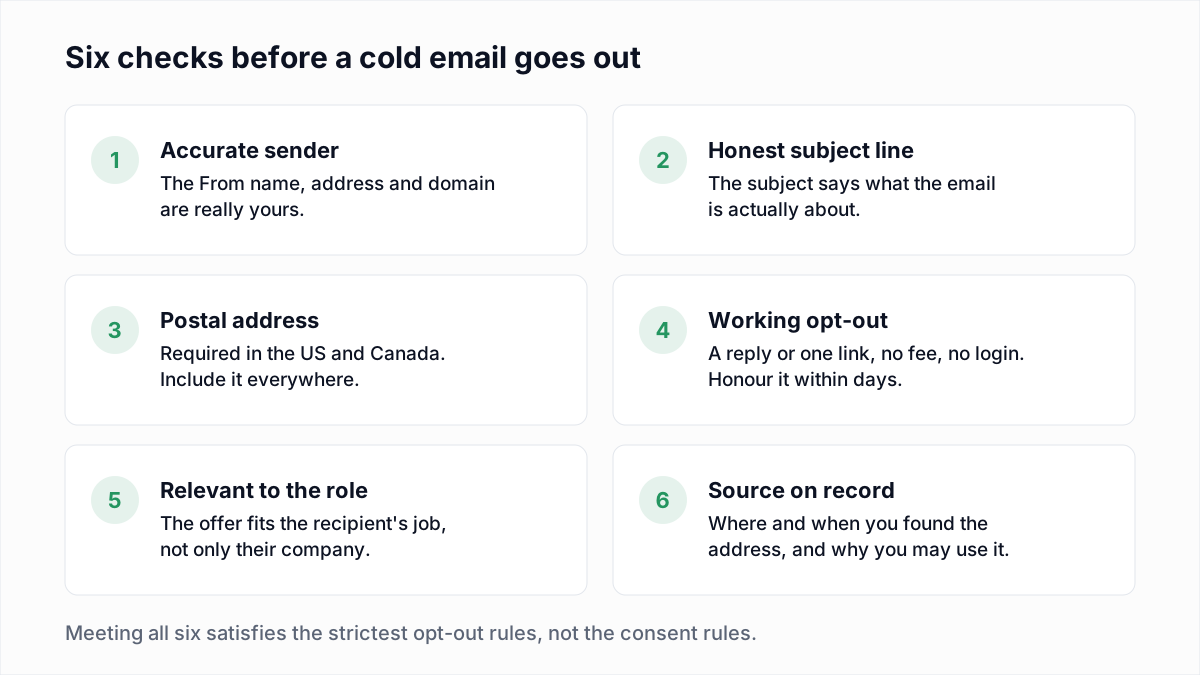
- Accurate sender. Your real name, company and domain in the From line. The US, UK, Canadian and Australian rules all require the sender to be identified.
- Honest subject line. The subject says what the message is about. CAN-SPAM bans deceptive subject lines outright.
- Physical address. Required by CAN-SPAM and CASL. Put it in the signature of every message, including follow-ups.
- Working opt-out, honoured promptly. A plain "reply and I will not write again" line meets CAN-SPAM, which allows a reply email or a single web page. Ten business days is the legal limit in the US and Canada; aim for the same day, and apply the opt-out across every mailbox, tool and agency you use. Bulk senders to Gmail and Yahoo also need the one-click List-Unsubscribe header.
- Relevance to the role. France and Canada make this a condition: the message must relate to the recipient's profession or role. A payroll pitch to a finance director passes. The same pitch to an engineer at that company does not.
- Records of source. Keep where and when you found each address and the page it was published on. CASL puts the burden of proof on you.
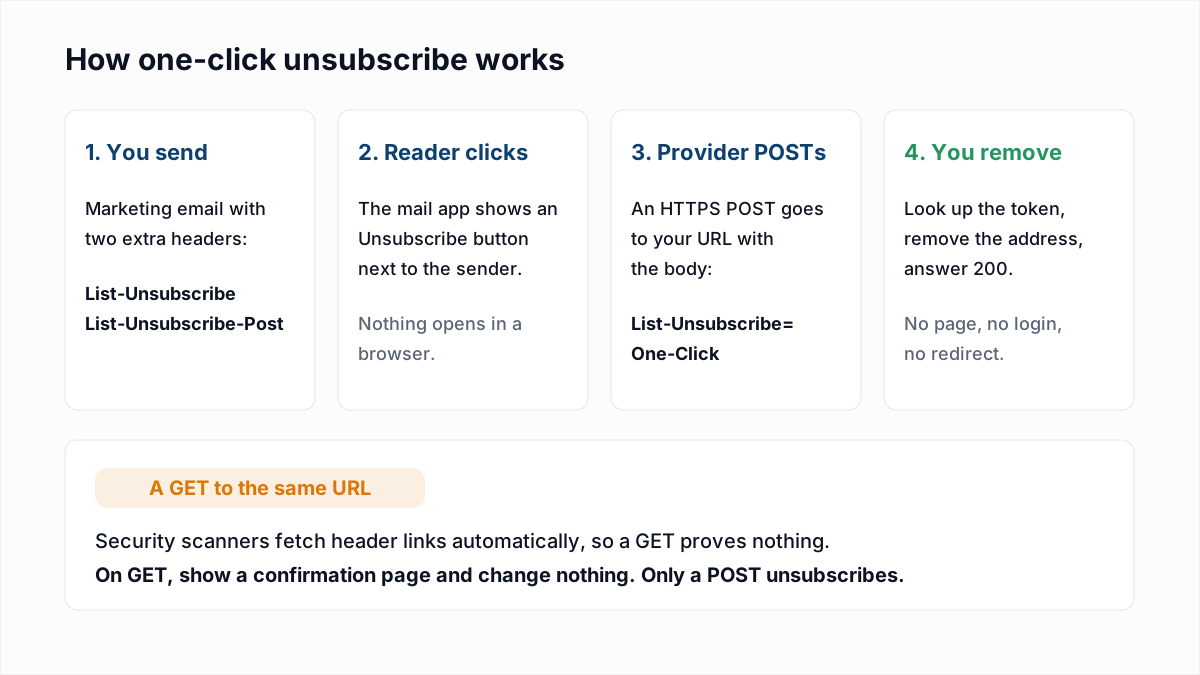
The law is also the lower bar. Gmail, Yahoo and Outlook filter on complaints and bounces whatever the statute allows; see why cold emails go to spam.
Does verifying an email list make cold email legal?
No, verifying an email list does not make cold email legal, because verification checks whether a mailbox exists and says nothing about consent, lawful basis or the content of the message.
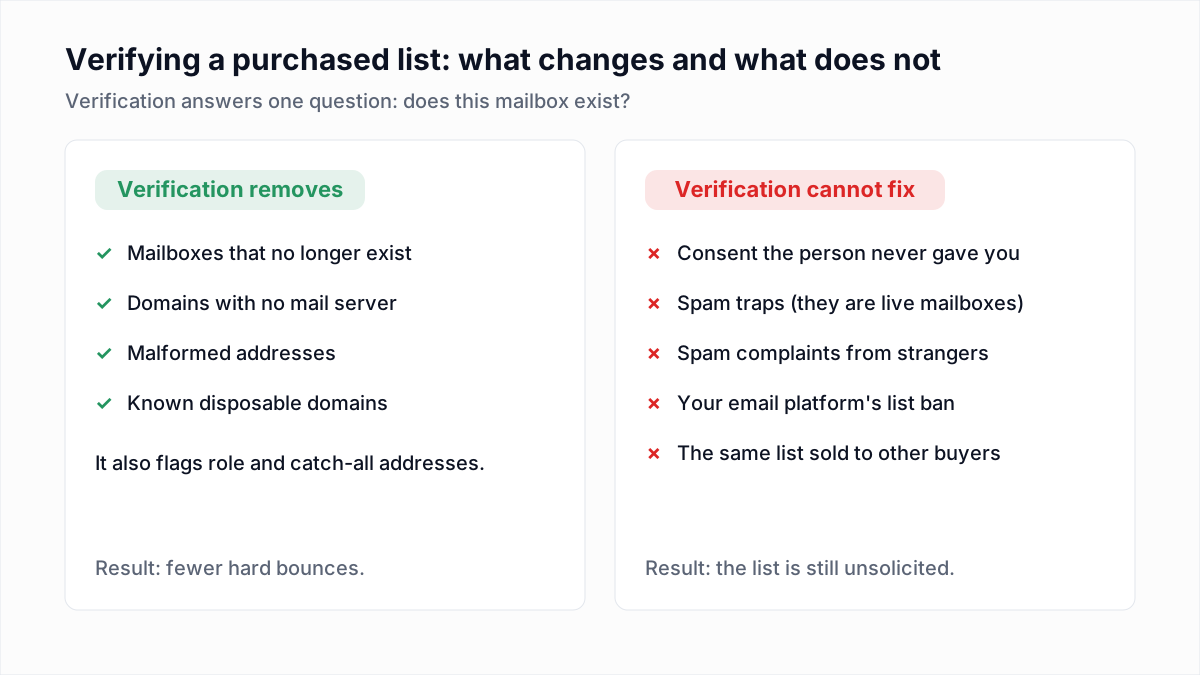
What verification does change is practical, and it supports compliance in two ways:
- Corporate or individual. InboxSure flags role accounts such as info@ and sales@ as Risky. That is a prompt, not a legal classification: the CNIL treats generic company addresses differently from named ones, and the ICO treats sole traders as individuals.
- Fewer wrong recipients. Removing Undeliverable addresses means fewer messages to mailboxes that no longer exist. The method is in how to clean a list before a cold email campaign.
InboxSure does not tell you whether a recipient is a sole trader, where they are located, or whether they opted out of someone else's list. Those checks stay with you.
Once a prospect list passes the legal checks, the bulk email verifier will tell you which addresses still exist. The Free plan covers lists of up to 50 addresses with no card, and Pro is a flat $49 a month for lists of up to 10,000 addresses.
Frequently asked questions
Related reading
Ready to clean your email list?
Upload a CSV or XLSX and get every address marked deliverable, risky, undeliverable or unknown, with the reason. Free for lists of up to 50, no card. Nothing is sent to your contacts.