Is Buying Email Lists Legal? Risks and What Happens Next
Two separate questions hide inside "is it legal to buy an email list". The first is whether the law where your recipients live lets you email people who never gave you their address. The second is whether your email platform and the mailbox providers will let you do it, and their rules are stricter than the law almost everywhere.
A purchased email list is a file of addresses sold or rented by a third party, where the people on it gave their address to someone else, or to nobody at all, and have no relationship with the buyer. The legal sections below summarise the regulators' own guidance as of November 2026 and are not legal advice; ask a lawyer about your own situation. For outreach to a list you built yourself, see is cold email legal.
Is it legal to buy an email list?
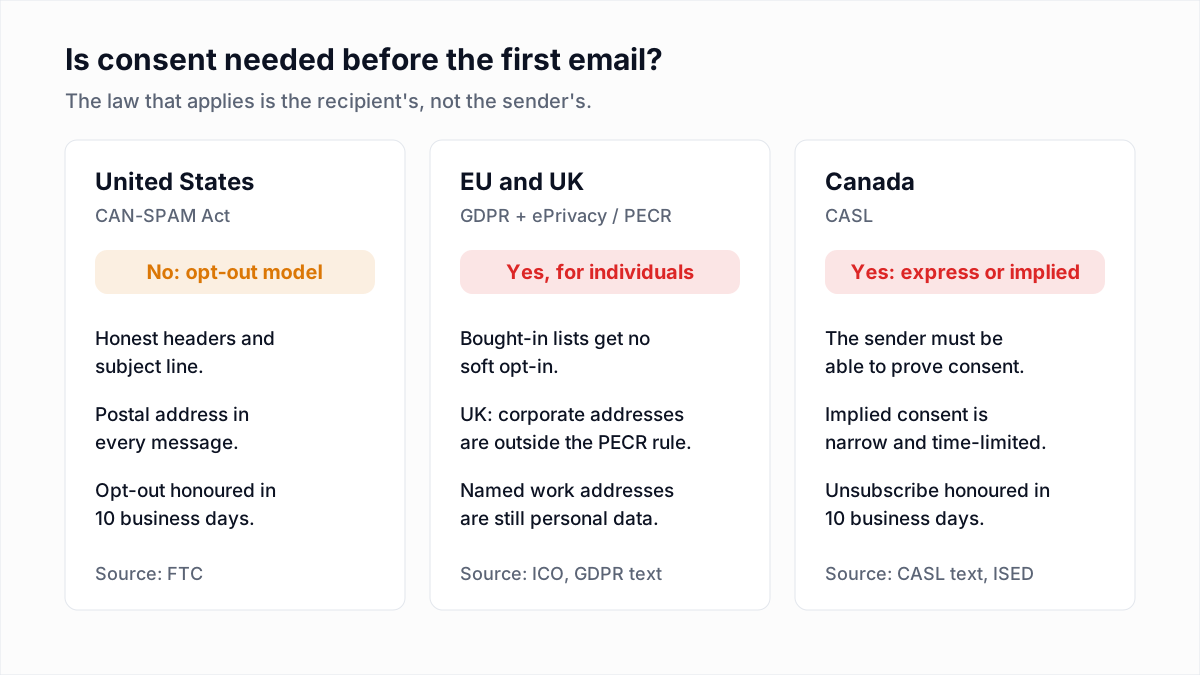
Buying an email list is legal to send to in the United States if every message follows CAN-SPAM, and generally not legal to send marketing to in the EU, the UK or Canada, where the sender needs each person's consent before the first message. The purchase is rarely the offence. The sending is.
The rule that applies is the one where the recipient is, not where you are, so a US company mailing a bought list with German, British and Canadian addresses on it is subject to all four regimes at once.
| Region and law | Is consent needed before the first marketing email? | Source |
|---|---|---|
| United States: CAN-SPAM Act | No. CAN-SPAM is an opt-out law: no prior consent is needed, but every message must meet the content and opt-out rules. | FTC CAN-SPAM compliance guide |
| European Union: ePrivacy Directive and GDPR | Yes for individuals. Article 13 of the ePrivacy Directive requires prior consent; rules for company addresses vary by member state. | Directive 2002/58/EC, Article 13 |
| United Kingdom: PECR and UK GDPR | Yes for individuals, sole traders and some partnerships. No PECR consent is needed for corporate subscribers, but UK GDPR still applies to named people. | ICO guide to electronic mail marketing |
| Canada: CASL | Yes. CASL requires express or implied consent, and the sender must be ready to prove it. | CASL, sections 6 and 10 |
Is buying an email list legal in the United States?
Buying and emailing a purchased list is legal in the United States as long as each message complies with the CAN-SPAM Act, because CAN-SPAM sets rules for the message and does not require opt-in. The FTC's CAN-SPAM compliance guide lists what every commercial email needs:
- No "false or misleading header information" and no deceptive subject lines.
- A "valid physical postal address" in the message.
- "A clear and conspicuous explanation of how the recipient can opt out", with the opt-out mechanism able to process requests for at least 30 days after you send.
- Opt-out requests honoured "within 10 business days".
Three points in the same guide matter for bought lists. First, the FTC guide says "the law makes no exception for business-to-business email". Second, once someone opts out, "you can't sell or transfer their email addresses, even in the form of a mailing list", so a list that includes people who unsubscribed from the original collector should not have been sold at all. Third, the guide describes aggravated violations that can add to the fines, including "harvesting email addresses or generating them through a dictionary attack", which is how many cheap lists are built. The guide states that each separate email in violation is subject to penalties of up to $53,088.
Is buying an email list legal in the EU and the UK?
Sending marketing email to a purchased list of individuals is generally not legal in the EU or the UK, because both require the person's prior consent to that sender and a list seller cannot hand you consent that was given to someone else.
In the EU the rule is Article 13 of the ePrivacy Directive, which allows electronic mail for direct marketing only to people "who have given their prior consent", with an exception only for your own customers. Article 13 covers natural persons and leaves company subscribers to each member state, so B2B rules differ from country to country.
In the UK, the ICO's guide to electronic mail marketing says "you must not send marketing emails or texts to individuals without specific consent", and that the soft opt-in for existing customers "does not apply to prospective customers or new contacts (eg from bought-in lists)".
Business addresses are treated differently in the UK, with conditions. The ICO's business-to-business marketing guidance says the PECR email rule "does not apply to corporate subscribers", but sole traders and some partnerships count as individuals. A work address that names a person, such as firstname.lastname@company, is still personal data under UK GDPR "even if they are acting in their business capacity". That means you need a lawful basis (the ICO points to the legitimate interests three-part test), you must tell people you have obtained their data, and their right to object to direct marketing "is absolute". Article 14 of the GDPR sets the deadline for that notice: within one month of obtaining the data, or at the first communication with the person if that comes sooner, including the source the data came from.
Is buying an email list legal in Canada?
Sending commercial email to a purchased list is generally not legal in Canada, because CASL prohibits commercial electronic messages unless the recipient has consented. Section 6 of CASL makes it prohibited to send a commercial electronic message unless "the person to whom the message is sent has consented to receiving it, whether the consent is express or implied".
Implied consent is narrow. Section 10 of the Act lists the cases, mainly an existing business relationship, or an address the person "has conspicuously published" without a no-solicitation statement, where the message is relevant to the person's business role. The Government of Canada's fightspam.gc.ca page on getting consent adds that implied consent "may be valid for up to 2 years" and that "senders should be ready to provide proof of this consent". The Act sets the maximum penalty per violation at $1,000,000 for an individual and $10,000,000 for any other person, and CASL is enforced by the CRTC.
Do email platforms allow purchased lists?
No, the major email platforms ban purchased lists in their terms, regardless of what the law allows in your country. These are their own words, checked in November 2026:
| Platform | What its policy says about purchased lists |
|---|---|
| Mailchimp Acceptable Use Policy | Users may not "upload or send email Campaigns to purchased, rented, third-party, co-reg, publicly available data, or partner lists of any kind." |
| HubSpot Anti-Spam Policy | "You are strictly prohibited from using the HubSpot Services to directly contact recipients from purchased, rented, borrowed, or other third-party lists". |
| Klaviyo Acceptable Use Policy | Prohibits sending to contacts "that are purchased, rented, borrowed, third-party owned/provided or any other lists that have not consented to receive communications" from your business. |
| Brevo Anti-Spam Policy | Lists "scraped on the internet, acquired or purchased from a third-party" are "strictly prohibited on our Software". |
The mailbox providers say the same from the receiving side. Google's email sender guidelines say "Don't purchase email addresses from other companies." Yahoo's sender best practices say "Don't purchase mailing lists".
What happens when you send to a purchased list?
Sending to a purchased list usually produces a spike in hard bounces and spam complaints within the first campaign, followed by spam-folder placement or an account suspension. The order is predictable:
- Hard bounces arrive first. Bought lists are old, and some addresses were guessed and never existed. Each one returns a reply such as
550 5.1.1 The email account that you tried to reach does not exist. HubSpot's Anti-Spam Policy, for example, requires "bounce rates below 5%", and a platform can pause an account on that number alone. Other published limits are in what is a good email bounce rate. - Complaints follow. People who never heard of you press "Report spam". Gmail and Yahoo expect senders to stay under 0.3%, which is three reports per thousand delivered messages; the detail is in spam complaint rate explained.
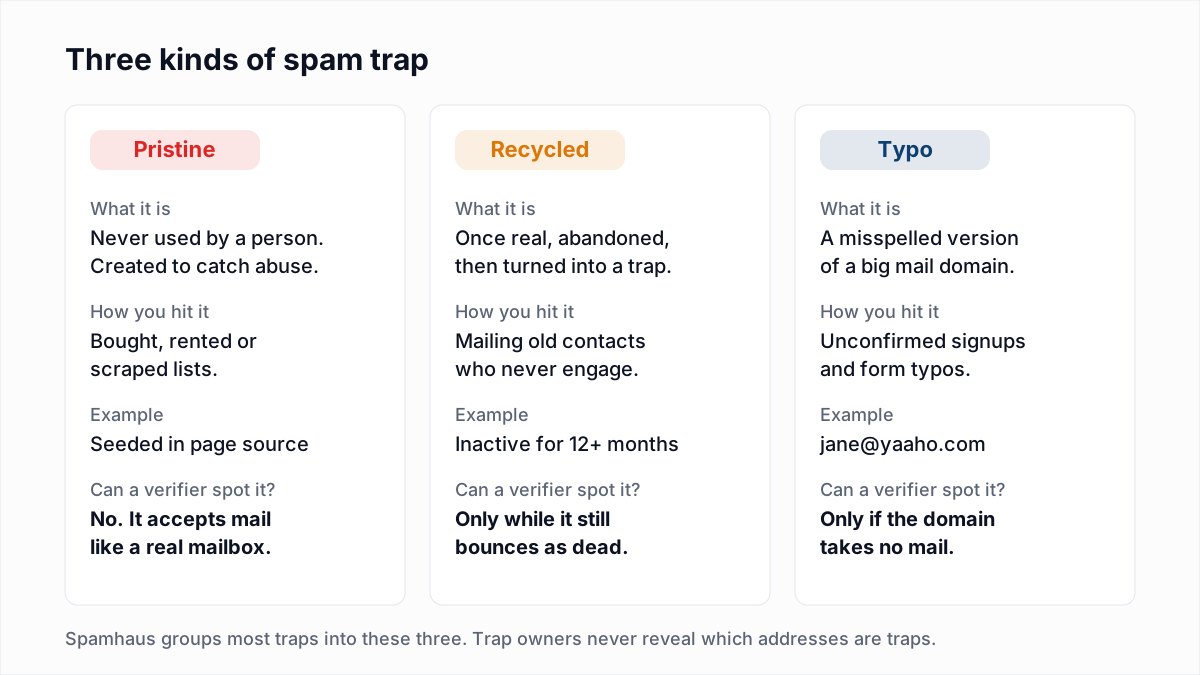
- Spam traps get hit. Scraped lists can carry pristine traps, and old lists can carry recycled ones. Nothing bounces and nothing warns you; the spam trap guide covers each type.
- Filtering or a block list entry. Reputation drops for the whole sending domain, so mail to your real customers lands in spam too; see email blacklist check and removal.
- The platform acts. The sending platform sees the same numbers and suspends the account under the policies quoted above.
Can you verify a purchased email list?
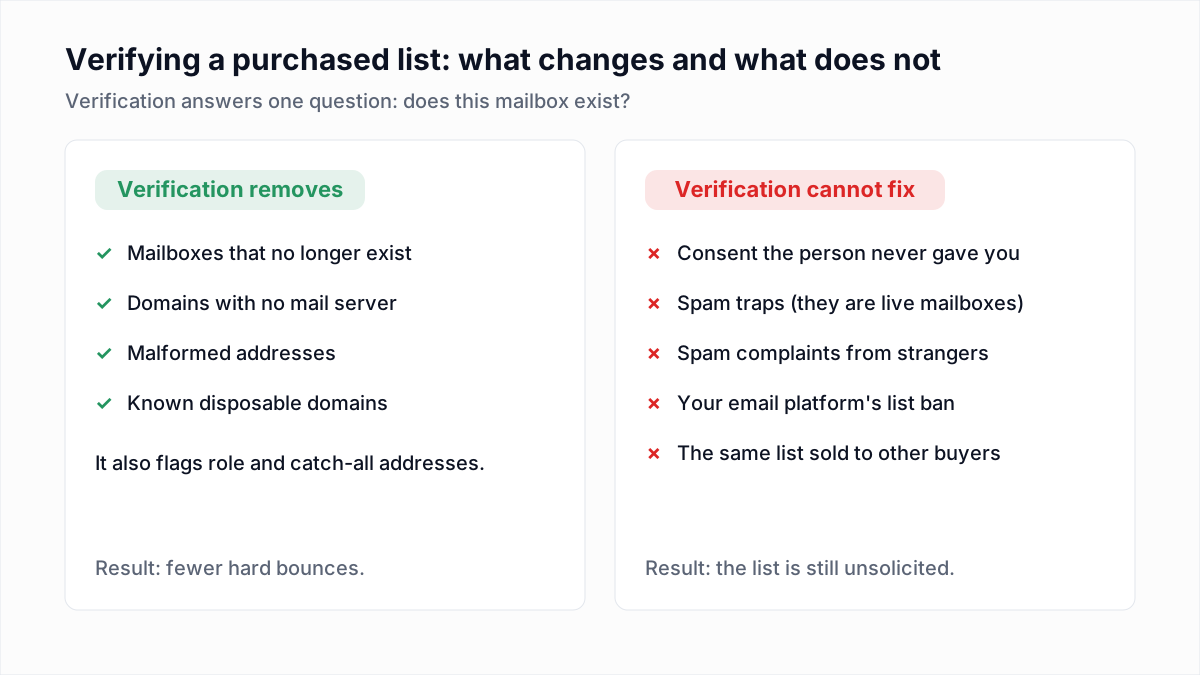
Yes, you can verify a purchased email list, and verification will remove the addresses that no longer exist, but verification does not create consent and cannot find spam traps. A verified bought list is a bought list with fewer bounces.
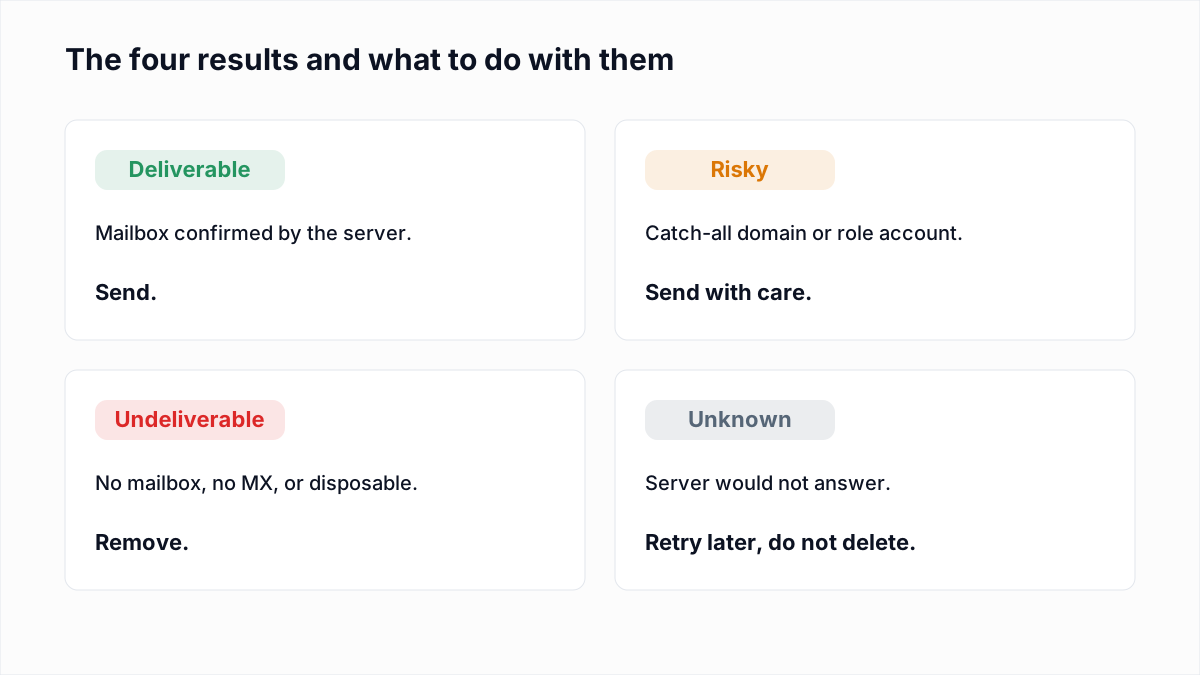
To be plain about our own product: InboxSure does not detect spam traps and does not tell you whether you are allowed to email anyone. It checks syntax, DNS and MX records, and the mailbox over SMTP, and returns Deliverable, Risky (catch-all or role account), Undeliverable or Unknown. Consumer Yahoo, AOL, Outlook.com and Hotmail addresses currently come back Unknown, because those providers refuse the check before the recipient is named, as our provider research from 4 November 2026 shows.
Is B2B prospect data from a provider the same as a purchased list?
B2B prospect data from a provider is a different case from a bulk purchased list, because you select named contacts by role and company and write to each one about their job, but the same consent laws and platform policies still apply to it.
The honest caveats:
- Law. In the US, CAN-SPAM applies in full. In the UK, corporate addresses sit outside the PECR consent rule, but a named work address is personal data, so you need a lawful basis, a notice and a working objection route. In Canada you need the conspicuous-publication or existing-relationship form of implied consent, and in EU member states the B2B position varies.
- Platforms. The Mailchimp, HubSpot, Klaviyo and Brevo policies above make no exception for B2B data, so cold outreach is normally sent from individual mailboxes on a separate domain, in small daily volumes.
- Data age. People change jobs, so provider data decays. Verify it shortly before sending, not when you export it.
The working method for prospect lists is in how to clean an email list before a cold email campaign, and the reasons cold mail gets filtered are in why cold emails go to spam.
What should you do if you already bought a list?
If you already bought a list, keep the list apart from your opted-in contacts and decide, region by region, whether you have a lawful reason to write to anyone on it.
- Keep it out of your marketing account. Importing it breaks the platform's terms.
- Ask the seller for consent records: the date, the wording the person agreed to, and whether your company was named. No records means no consent.
- Split by region. Remove EU, UK and Canadian individuals unless you can show consent or one of the narrow exceptions above.
- Verify what is left, drop everything Undeliverable, and remove role addresses.
- Send individually and slowly, from a separate domain, with a postal address and an opt-out in every message, and stop at the first sign of complaints.
The better use of the same budget is a list people join themselves: a sign-up form with double opt-in, a one-click unsubscribe header, and a regular clean. That is the only kind of list every law and platform above accepts.
InboxSure is for the list you are entitled to send to: your own sign-ups, your customers, or prospect data you have a lawful basis for. The Free plan verifies lists of up to 50 addresses with no card, and Pro is a flat $49 a month for lists of up to 10,000 addresses. Upload a CSV to the bulk email verifier and download the results with a reason for every address.
Frequently asked questions
Related reading
Ready to clean your email list?
Upload a CSV or XLSX and get every address marked deliverable, risky, undeliverable or unknown, with the reason. Free for lists of up to 50, no card. Nothing is sent to your contacts.