Null MX Record: What 556 5.1.10 Means and When to Publish One
A null MX record is a single MX record with preference 0 and a lone dot as its target, and it tells every sending server that the domain accepts no email. Two kinds of reader land here: someone whose message bounced with 556 5.1.10, and a domain owner deciding whether to publish one. This page covers the record, the bounce, when to publish one, and how to add and test it. For how ordinary MX records work, see what is an MX record.
What does a null MX record look like?
A null MX record looks like any other MX record, except that the preference is 0 and the mail server name is a single dot. In zone-file form:
example.com. IN MX 0 .The record is defined in RFC 7505, published in June 2015. Section 3 says a domain that does not accept email "advertises a single MX RR" with "preference number 0 and a zero-length label, written in master files as ".", as the exchange domain, to denote that there exists no mail exchanger for a domain." It adds: "Since "." is not a valid host name, a null MX record cannot be confused with an ordinary MX record."
One rule comes with it. RFC 7505 says: "A domain that advertises a null MX MUST NOT advertise any other MX RR." A null MX next to a real MX is a mistake, not a backup.
What does 556 5.1.10 mean?
556 5.1.10 means the recipient's domain publishes a null MX record, so no mail server exists for it and the message was refused without a delivery attempt. RFC 7505 section 4.1 says a server that rejects a recipient for this reason "SHOULD use a 556 reply code (Requested action not taken: domain does not accept mail) and a 5.1.10 enhanced status code (Permanent failure: Recipient address has null MX)."
The reply comes from your own outgoing server or sending platform, not from the recipient, because there is no recipient server to connect to. Three things follow:
- 556 5.1.10 is permanent. Retrying will not help, and every address at that domain fails the same way.
- The usual cause is a typo. RFC 7505 gives the examples
alice@www.example.comandalice@examp1e.comwritten in place ofalice@example.com. Check the spelling of the domain before anything else. - The wording varies. The word SHOULD leaves room, and not every mail server uses 556 or the same text. Microsoft also uses 5.1.10 for an unrelated "recipient not found" error, as noted in email bounce codes. Read the text, not only the number.
What is 550 5.7.27?
550 5.7.27 is the sender-side twin of 556 5.1.10: a receiving server refused a message because the sender's domain has a null MX. RFC 7505 says servers that reject mail because the envelope sender or From domain has a null MX "SHOULD use a 550 reply code (Requested action not taken: mailbox unavailable) and a 5.7.27 enhanced status code (Permanent failure: Sender address has null MX)." A domain that cannot receive replies or bounces is not a believable sender.
| Reply | Who has the null MX | What to do |
|---|---|---|
| 556 5.1.10 Recipient address has null MX | The domain you are sending to accepts no mail. | Correct the address or remove it. Do not retry. |
| 550 5.7.27 Sender address has null MX | Your own sending domain publishes a null MX. | Send from a domain with a working MX, or replace the null MX. |
How is a null MX different from having no MX record at all?
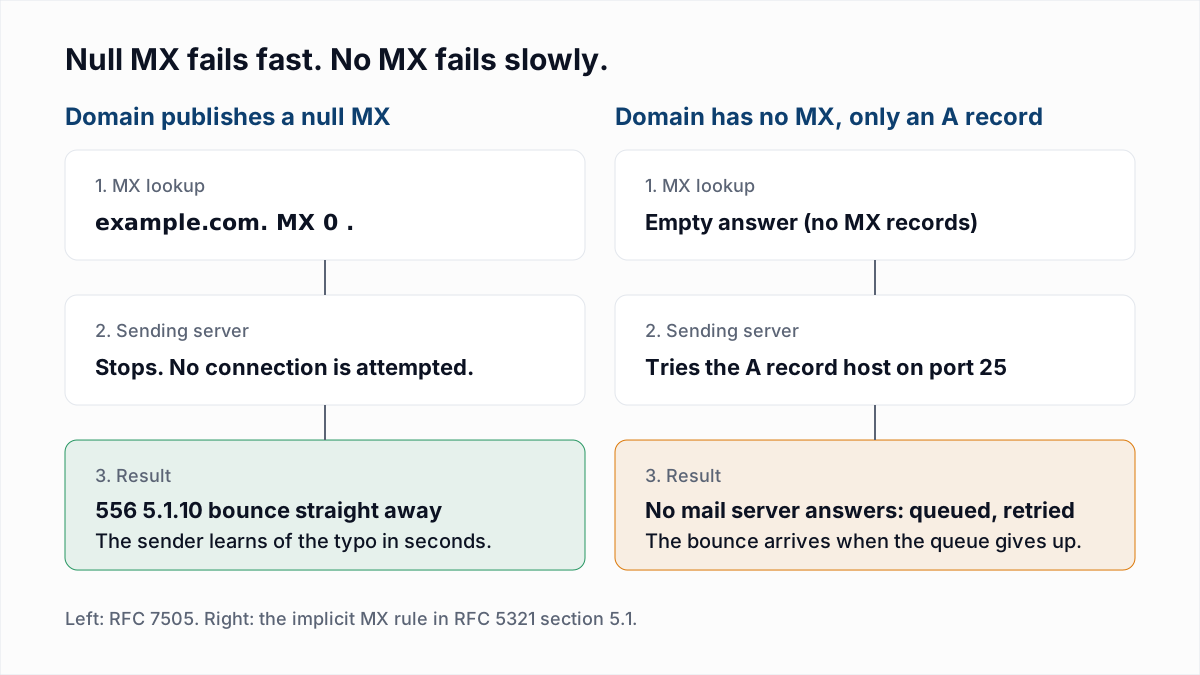
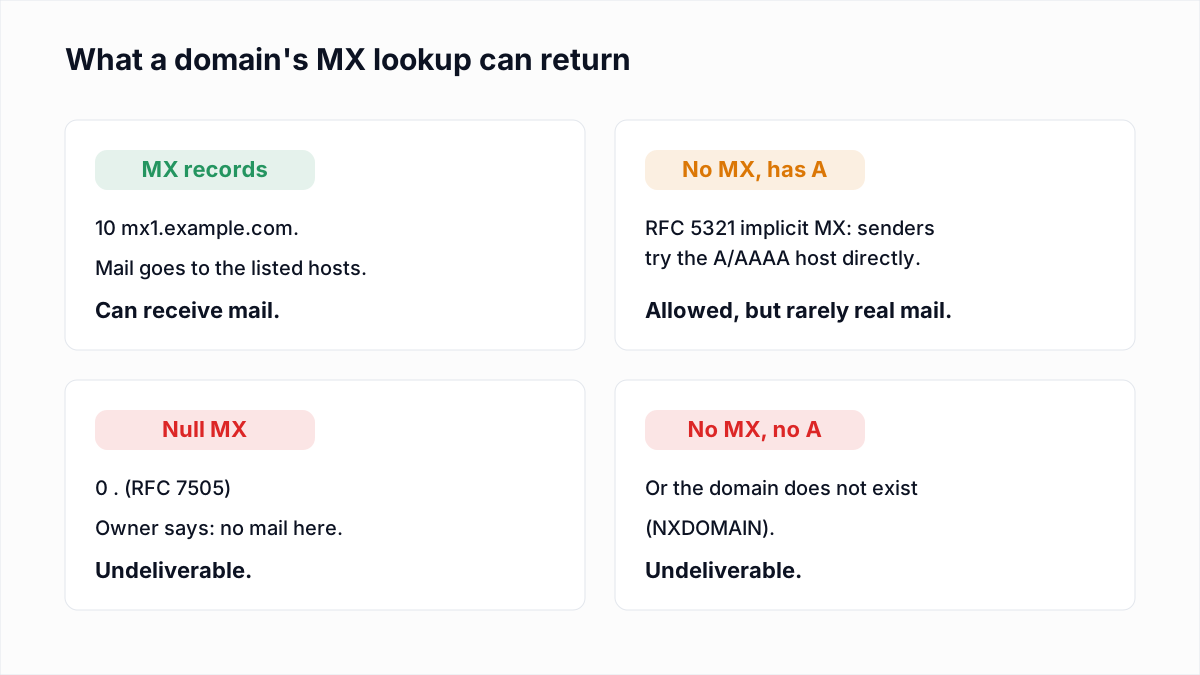
A null MX is an explicit "no mail here", while a missing MX record makes sending servers fall back to the domain's A or AAAA record. That fallback is the implicit MX rule in RFC 5321 section 5.1: "If an empty list of MXs is returned, the address is treated as if it was associated with an implicit MX RR, with a preference of 0, pointing to that host."
So a domain with a website and no MX still gets delivery attempts, aimed at the web server. If nothing answers on port 25, the sender keeps the message queued and retries until its queue lifetime runs out. RFC 7505 lists what the null MX changes: a mail system can "report the delivery failure when the user sends the message, rather than hours or days later", and a sending server "will discover on the first sending attempt that an address is not deliverable, avoiding queuing and retries."
| MX lookup result | What a sending server does | Outcome for the sender |
|---|---|---|
| One or more normal MX records | Connects to the listed hosts in preference order. | Mail is delivered or refused by that server. |
| Null MX (0 .) | Makes no connection and fails the message. | An immediate permanent bounce, ideally 556 5.1.10. |
| No MX, but an A or AAAA record | Tries the A or AAAA host as an implicit MX. | Usually a delayed bounce after retries. |
| Domain does not exist (NXDOMAIN) | Reports an error, as RFC 5321 requires. | An immediate permanent bounce. |
When should you publish a null MX record?
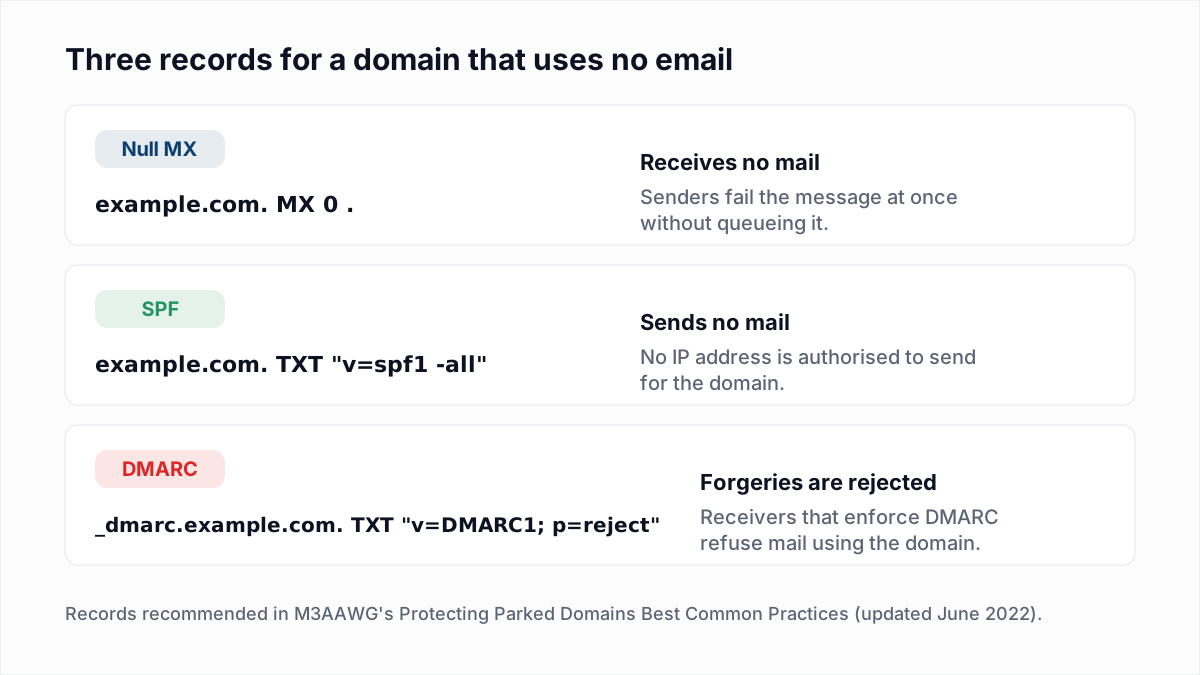
You should publish a null MX record on any domain or subdomain that will never receive email: parked domains, defensive registrations, and names used only for a website. The M3AAWG document Protecting Parked Domains Best Common Practices (updated June 2022) calls it "the recommended way to indicate that a domain is not meant to receive email".
A null MX only covers receiving. M3AAWG pairs it with two records that cover sending, so nobody can forge the idle domain:
example.com.          MX   0 .
example.com.          TXT  "v=spf1 -all"
_dmarc.example.com. TXT "v=DMARC1; p=reject"- SPF. M3AAWG says any domain that never sends email should publish a "naked"
-all, which means no IP is authorised to send for it. - DMARC. M3AAWG says such a domain should publish
p=reject. Theruareporting tag is optional; if you add one, point it at a domain that does receive mail. Policies are compared in DMARC none vs quarantine vs reject. - DKIM. M3AAWG says no DKIM record is needed for a parked domain "and in fact none should be published."
- Subdomains. M3AAWG suggests wildcard records such as
*.example.com MX 0 .if your DNS policy allows them.
When should you not publish one?
Do not publish a null MX on a domain that appears in the From address or Return-Path of mail you send. RFC 7505 section 4.2 says mail systems "SHOULD NOT publish a null MX record for domains that they use in RFC5321.MailFrom or RFC5322.From addresses. If a system nonetheless does so, it risks having its mail rejected." That includes a no-reply address: the sending domain still needs a working MX. Check every subdomain your platforms send from before adding wildcard records.
How do you add a null MX record at a DNS host?
You add a null MX record the same way as any MX record, with 0 as the priority and a single dot as the mail server. The field names differ between DNS hosts, but the steps are the same:
- Open the DNS settings for the domain at whoever hosts its DNS zone.
- Delete every existing MX record. A null MX must be the only one.
- Add a record of type MX. Set the name or host to
@(or leave it blank) for the root domain, or to the subdomain label. - Set the priority to
0and the mail server, value or target to a single dot:. - Add the SPF and DMARC TXT records above if the domain sends no mail either. The DMARC generator builds the DMARC value.
- Save, wait for the change to reach the name servers, and test it.
Some DNS control panels validate the target field as a host name and refuse a lone dot. We have not tested each provider, so if yours rejects the value, search its documentation for "null MX" or ask its support.
How do you test a null MX record with dig?
You test a null MX record by running dig MX on the domain and checking that the only answer is 0 .. This is the real output for example.com, the domain reserved for documentation, on 13 November 2026:
$ dig +noall +answer MX example.com
example.com.		56	IN	MX	0 .

$ dig +noall +answer TXT example.com
example.com.		300	IN	TXT	"v=spf1 -all"
example.com.		300	IN	TXT	"_k2n1y4vw3qtb4skdx9e7dxt97qrmmq9"

$ dig +noall +answer TXT _dmarc.example.com
_dmarc.example.com.	300	IN	TXT	"v=DMARC1;p=reject;sp=reject;adkim=s;aspf=s"
That is the full no-mail set on a live domain: a null MX, an SPF record of -all, and DMARC at reject. The second TXT record is unrelated to mail. The number after the name is the remaining cache time in seconds and will differ when you run it. On Windows, nslookup -type=mx example.com gives the same answer in a different layout.
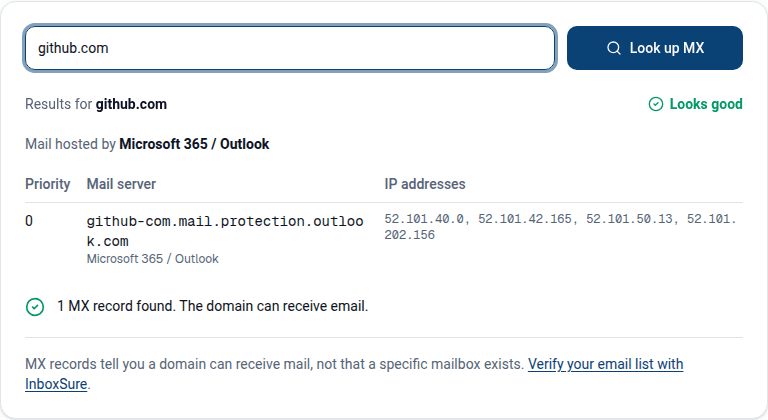
Without a terminal, the free MX lookup tool lists a domain's MX records and labels a null MX as one.
How do email verifiers treat a null MX record?
An email verifier should treat every address at a null MX domain as undeliverable, because the domain owner has said so in DNS and no SMTP check is possible. Whether a given tool does is worth testing with an example.com address.
Here is what InboxSure does, read from the verifier's code on 13 November 2026. The code has no separate rule for a null MX. It reads the record as an MX answer whose host name is empty, the SMTP connection to that empty host cannot be made, and the address is reported as Unknown, not Undeliverable. A domain with no MX record at all is handled differently: InboxSure marks it Undeliverable and does not try the A record.
So if a list comes back with Unknown results, run the domain through the MX lookup before deciding. If it shows a null MX, remove the address: nothing sent there can arrive. Other causes of Unknown, which do deserve a retry, are in greylisting and Unknown results.
To check a whole list for dead domains and mailboxes before a send, the bulk email verifier takes a CSV and returns Deliverable, Risky, Undeliverable and Unknown for each address. The Free plan handles lists up to 50 addresses with no card, and Pro is a flat $49 a month for lists up to 10,000.
Frequently asked questions
Related reading
Ready to clean your email list?
Upload a CSV or XLSX and get every address marked deliverable, risky, undeliverable or unknown, with the reason. Free for lists of up to 50, no card. Nothing is sent to your contacts.