What Is BIMI? Requirements, Record and Cost
BIMI is a display feature, not a delivery feature. The record itself is one line of DNS and costs nothing. What takes the time and the money is everything it depends on: a DMARC policy that is actually enforced, a logo redrawn in a restricted SVG profile, and, for Gmail, a certificate that proves the logo is yours.
BIMI stands for Brand Indicators for Message Identification. It sits on top of SPF, DKIM and DMARC, so if those are new to you, start with our guide to email authentication.
What does BIMI show, and where?
BIMI shows your logo in the round avatar slot next to your sender name, in the message list or the open message, in mailbox providers that support it. Where a sender has no BIMI logo, the same slot holds initials or a generic icon.
Support differs by provider, and each one sets its own conditions. The table reflects each provider's own page as we read it on 13 November 2026.
| Mailbox provider | BIMI support as of November 2026 | Certificate needed? |
|---|---|---|
| Gmail and Google Workspace | Gmail shows the logo, and adds a verified checkmark next to the sender name when the logo is backed by a VMC. The checkmark appears on the web and in the Gmail apps for Android and iOS. | Yes. Gmail accepts a VMC or a CMC and does not support a record that points only to an SVG file. |
| Yahoo Mail and AOL | Yahoo shows the logo in the message list and the open message in its mobile apps, and in the open message on desktop webmail, for bulk mail from senders with enough reputation and engagement. | No. Yahoo's Sender Hub says it does not currently require a VMC, but uses one if present. |
| Apple Mail | Apple Mail supports BIMI in iOS 16, iPadOS 16, macOS Ventura 13 or later, and on iCloud.com, and marks such messages as digitally certified. The recipient's email provider must support BIMI too. | Apple says BIMI works with VMCs and other forms of BIMI evidence documents. The BIMI Group's FAQ says Apple requires a VMC, so plan for one. |
| Fastmail, Zoho Mail, La Poste and others | The BIMI Group lists these providers, along with Comcast, KDDI, NTT docomo, OnetPoczta, Zone, Zoner and Cloudmark, as supporting BIMI. | Set by each provider. |
| Microsoft Outlook, Outlook.com and Microsoft 365 | Microsoft does not support BIMI. The BIMI Group lists Microsoft as the one large provider that does not, and we found no Microsoft announcement of a date. | Not applicable. |
Sources: Google's Set up BIMI help page (last updated 10 November 2026), Yahoo's Sender Hub BIMI page, Apple's support article on BIMI in Apple Mail, and the BIMI Group's provider support list (last updated May 2025). The practical consequence of the Microsoft row: if most of your recipients read mail in Outlook, most of them will never see the logo.
What are the requirements for BIMI?
BIMI requires a DMARC policy of p=quarantine or p=reject with pct=100, a logo in the SVG Tiny PS format, a TXT record at default._bimi, and for Gmail a mark certificate.
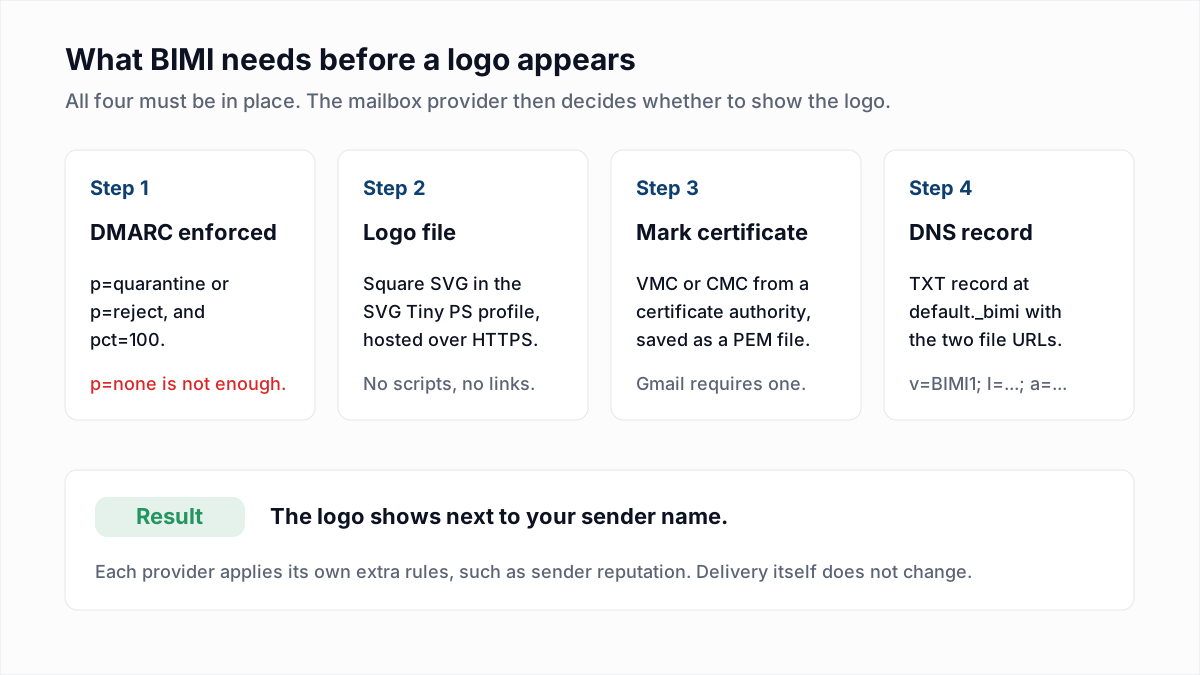
The DMARC rule is the one that stops most domains. Google's BIMI help page states it in two lines: "The policy option (p) must be set to quarantine or reject" and "The percent option (pct) must be set to 100". A domain at p=none, or at p=quarantine; pct=50, does not qualify. Leaving pct out is fine, because 100 is the default in RFC 7489. RFC 9989, which replaced RFC 7489 in May 2026, removed the pct tag (see what DMARC is), but Google's page still states the requirement this way as of 13 November 2026, so a record that carries pct must carry 100.
The BIMI Group's implementation guide goes further and says the policy must be enforced on the organizational domain and its subdomains, so a weak sp=none can disqualify you as well. Yahoo's Sender Hub asks for the same level: "A DMARC policy of quarantine or reject is in place".
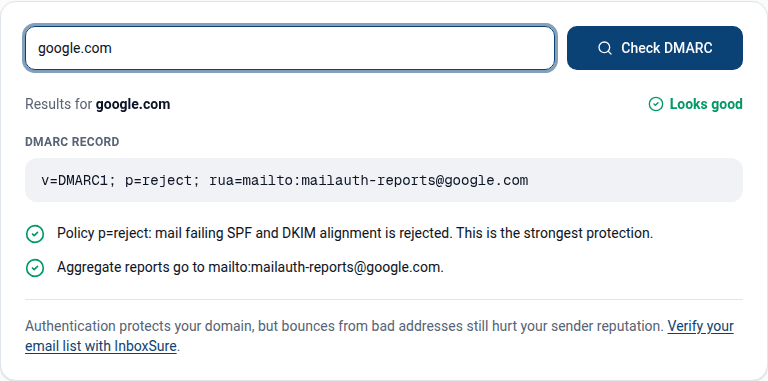
Getting to enforcement safely is its own project. Our guide to DMARC policies: none, quarantine and reject has the rollout timeline, and how to read DMARC reports shows how to tell when every legitimate sender passes. You can see what your domain publishes today with the free DMARC checker.
What logo format does BIMI need?
BIMI needs the logo as an SVG file in the SVG Tiny Portable/Secure profile, called SVG Tiny PS, served over HTTPS. A PNG, a JPEG or an ordinary SVG exported from a design tool is not accepted.
Google's help page lists what the file must and must not contain:
- The root element declares
baseProfile="tiny-ps"andversion="1.2". - No scripts, no animation, no interactive elements, and no external links or references other than the XML namespaces.
- No
x=ory=attributes on the root<svg>element. - For Gmail, a height and width of at least 96 pixels, given in absolute pixels and not relative units.
- Recommended by Google: a square logo on a solid background, in a file of 32 KB or less.
The avatar slot is a circle in most clients, so use the square or icon version of your logo, not a wide wordmark.
What is the difference between a VMC and a CMC?
A Verified Mark Certificate (VMC) proves the logo is a registered trademark and earns the Gmail verified checkmark. A Common Mark Certificate (CMC) needs no registered trademark and shows the logo in Gmail without the checkmark.
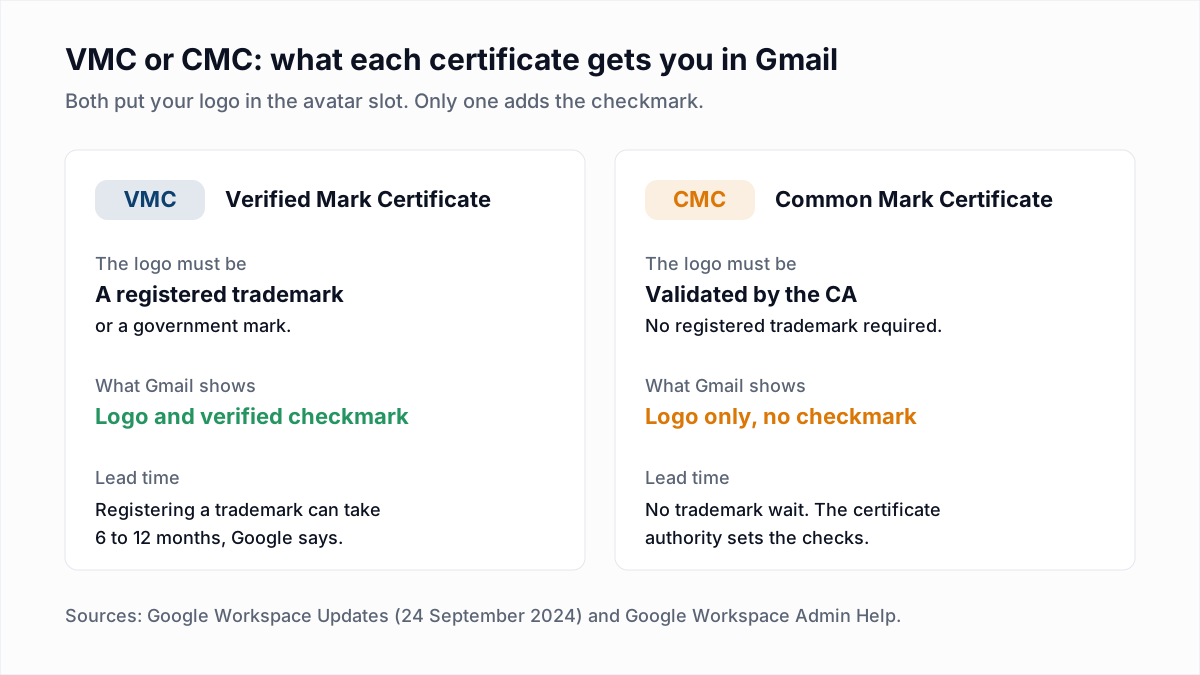
Both are issued by a certificate authority that checks your organization and your logo, then embeds the logo in a certificate file. Google added CMC support in a Workspace Updates post on 24 September 2024, which says that with a CMC "the sender's brand avatar will be displayed without the Gmail verified checkmark that's displayed for VMCs".
| Question | Verified Mark Certificate (VMC) | Common Mark Certificate (CMC) |
|---|---|---|
| What must the logo be? | A VMC requires a registered trademark or a government mark, per DigiCert's product page. | A CMC validates a logo that has not been registered as a trademark. |
| What does Gmail show? | Gmail shows the logo and the verified checkmark. | Gmail shows the logo without the checkmark. |
| How long does it take? | Google says registering a trademark can take 6 to 12 months if you do not have one yet. | There is no trademark wait; the certificate authority sets its own checks. |
This is the mark people call the "Gmail blue checkmark". Google's help text says: "In Gmail, you'll see a checkmark next to senders verified with a VMC." It is tied to the certificate type and cannot be bought separately.
What does a BIMI record look like?
A BIMI record is a DNS TXT record at default._bimi.yourdomain.com with three tags: v=BIMI1, l= for the logo URL and a= for the certificate URL.
This is the record CNN publishes at default._bimi.cnn.com, as returned by a DNS lookup on 13 November 2026:
default._bimi.cnn.com.  TXT
"v=BIMI1; l=https://amplify.valimail.com/bimi/time-warner/R4Ezf5xK5ac-CNN.svg; a=https://amplify.valimail.com/bimi/time-warner/R4Ezf5xK5ac-CNN.pem"
CNN's DMARC record on the same day was at p=reject, the enforcement BIMI needs. Look up any domain with dig TXT default._bimi.example.com.
| Part | What it means | Notes |
|---|---|---|
default._bimi | The record name is a selector followed by _bimi. | default is the selector receivers look up unless a message says otherwise. |
l= | The l tag holds the HTTPS URL of the SVG Tiny PS logo. | Google's own example leaves l= empty, because the logo is embedded in the certificate file. |
a= | The a tag holds the HTTPS URL of the VMC or CMC, as a PEM file. | The a tag is optional in the standard but required for Gmail, which supports BIMI only with PEM files. |
A record with only l= and no certificate is called self-asserted. Yahoo accepts it; Gmail does not.
How much does BIMI cost?
The BIMI record itself is free; the cost of BIMI is the mark certificate, which is an annual subscription priced by the certificate authority, plus trademark registration if you want a VMC and do not have a trademark.
The BIMI Group lists three authorized issuers: DigiCert, GlobalSign and SSL.com. Of these, the only public price we could read on a certificate authority's own page was DigiCert's. DigiCert's mark certificate page showed a 12-month auto-renewing subscription at $1,416.00 on 13 November 2026, with the note "Prices subject to change". The page offers both the Verified Mark and Common Mark types; confirm the figure for your type and number of domains in the cart before you budget for it. GlobalSign and SSL.com certificates are priced by the CA, and resellers quote their own prices.
The certificate renews every year for as long as you want the logo in Gmail, and a trademark application carries its own government and legal fees. If you only care about Yahoo Mail, none of the certificate cost applies.
Does BIMI improve deliverability?
No, BIMI does not improve deliverability directly. The BIMI Group's FAQ for senders says "BIMI does not change message delivery; it is a display signal on top of strong authentication", and neither Google's nor Yahoo's BIMI page claims an inbox-placement benefit.
The indirect effect is real but belongs to DMARC, not to the logo. To qualify you have to reach p=quarantine or p=reject, which stops others from spoofing your domain and is part of what Gmail, Yahoo and Outlook expect from bulk senders. Certificate vendors quote open-rate gains from their own studies; mailbox providers publish none, so we do not repeat them.
How do you set up BIMI?
You set up BIMI in six steps: enforce DMARC, prepare the logo, get the certificate, host the file, publish the record and test. The DMARC step takes the longest by far.
- Get SPF or DKIM passing with alignment for every sender. See what DKIM is and how to set it up.
- Move DMARC to enforcement. Go from
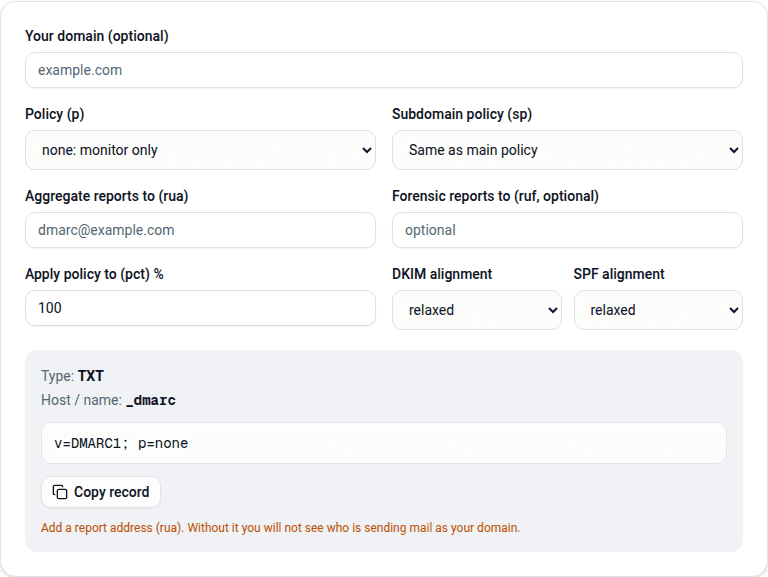
p=nonetop=quarantineorp=rejectatpct=100, including subdomains. The DMARC record generator writes the record for each stage. - Convert the square version of the logo to SVG Tiny PS.
- Buy a VMC or CMC from a certificate authority if you want the logo in Gmail. The authority returns a PEM file with the logo embedded.
- Host the PEM file on an HTTPS server. Google recommends TLS 1.2 or later.
- Publish the TXT record at
default._bimiand send yourself a test message. Google says the logo can take up to 48 hours to appear.
Why is my BIMI logo not showing?
A BIMI logo usually fails to show because DMARC is not fully enforced, the certificate is missing or invalid, the SVG is not valid Tiny PS, or the mailbox provider does not support BIMI at all.
| What you see | Likely cause | What to do |
|---|---|---|
| No logo in any mailbox | The DMARC policy is p=none, or pct is below 100. | Move DMARC to quarantine or reject at 100 percent, then wait up to 48 hours. |
| The logo shows in Yahoo Mail but not in Gmail | The record has no a= tag, or the PEM file cannot be fetched. | Get a VMC or CMC and check that the PEM URL loads over HTTPS. |
| The logo shows in Gmail but there is no checkmark | The certificate is a CMC. | A VMC, which needs a registered trademark, is the only way to the checkmark. |
| The logo shows in Gmail but not in Yahoo Mail | Yahoo does not yet see bulk volume, reputation or engagement for the address. | Keep complaint and bounce rates low and send consistently; there is no form to file. |
| No logo in Outlook | Microsoft does not support BIMI. | Nothing to fix on your side. |
Is BIMI worth it?
BIMI is worth setting up if you send consumer mail at volume to Gmail, Yahoo and Apple Mail users and your logo is one people recognise. It is poor value if your recipients mostly use Outlook. Either way, do the DMARC part: enforcement protects the domain whether or not you ever buy a certificate.
InboxSure does not set up or monitor BIMI. InboxSure verifies email lists, and that helps here in one narrow way: dead addresses bounce, bounces pull down the sender reputation Yahoo looks at before showing a logo, and removing them before a send is cheap. The bulk email verifier takes a CSV, and the Free plan covers lists of up to 50 addresses with no card.
Frequently asked questions
Related reading
Ready to clean your email list?
Upload a CSV or XLSX and get every address marked deliverable, risky, undeliverable or unknown, with the reason. Free for lists of up to 50, no card. Nothing is sent to your contacts.