Can You Verify Yahoo and AOL Email Addresses? Honest Answer
We sell email verification, and we cannot verify Yahoo or AOL addresses today. That is worth saying first, because most pages ranking for "Yahoo email checker" imply the opposite. When InboxSure checks a Yahoo address the result is Unknown. Unknown is a verification result that means the mail server did not give an answer about the mailbox, so the address is neither confirmed nor ruled out.
This post shows the exact reply behind that result, what Yahoo itself publishes about missing and inactive accounts, and what to do with the Yahoo addresses on a list when no check will settle them.
Why do Yahoo emails show Unknown in a verifier?
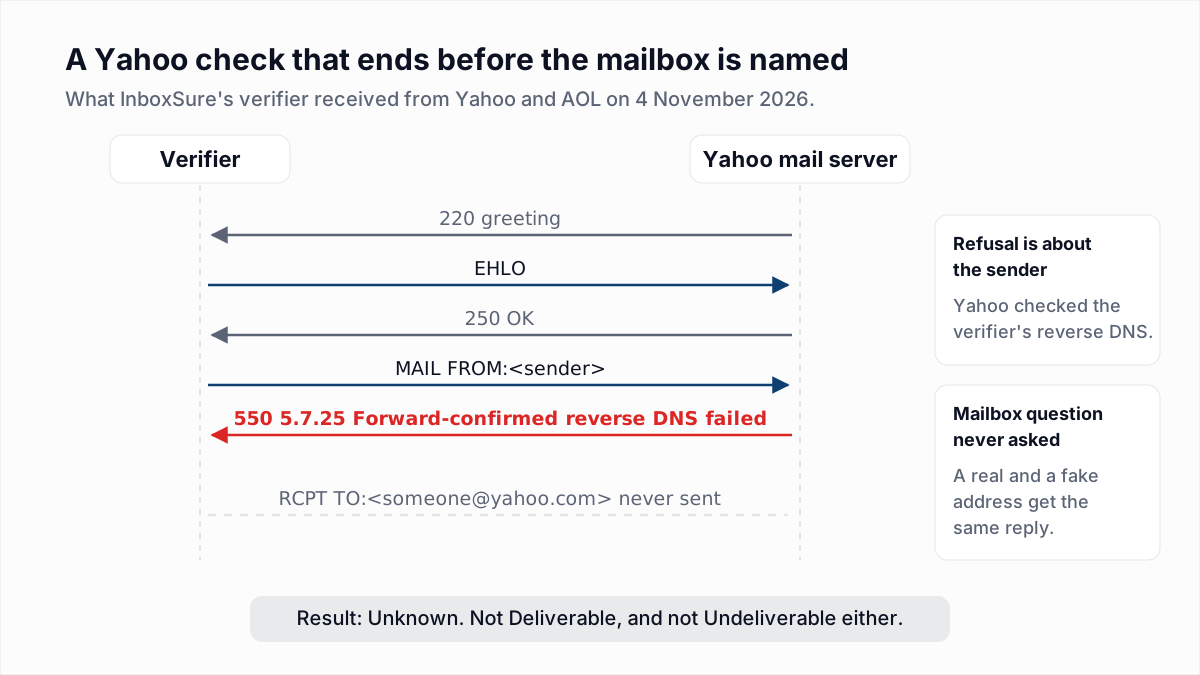
Yahoo emails show Unknown because Yahoo's servers can refuse the verifier itself before the mailbox is ever named, so the check ends without a per-address answer. A verifier works by opening an SMTP session, giving a sender at MAIL FROM, then naming the address at RCPT TO and reading the reply. The mailbox answer only exists at that last step.
In InboxSure's research on 4 November 2026, a check against yahoo.com and a check against aol.com both stopped one step earlier. Each server answered MAIL FROM with:
550 5.7.25 Forward-confirmed reverse DNS failedBoth domains are served by hosts under yahoodns.net, which is why the replies match. The address we asked about was random and could not exist, but that is beside the point: a real address would have received the same reply, because the recipient was never sent. The full capture is in how Gmail, Outlook and Yahoo respond to email verification.
What 550 5.7.25 means here
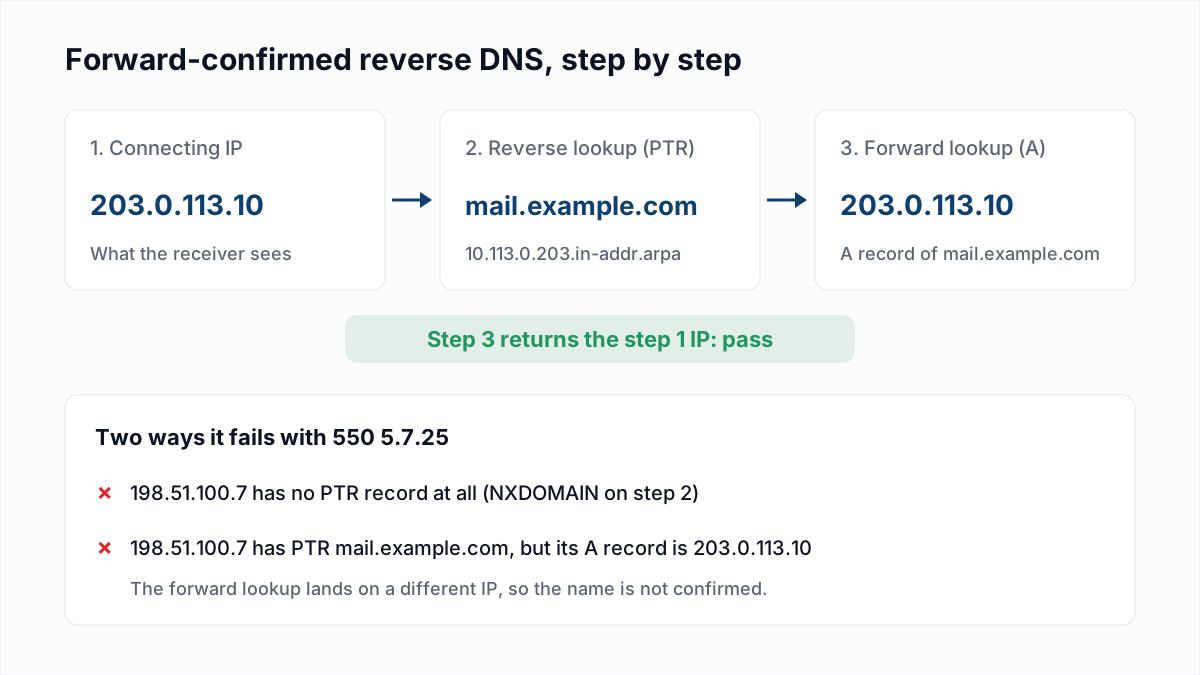
Code 5.7.25 is a reverse DNS refusal. Yahoo looked up the PTR record for the connecting IP, then checked that the name it found resolves back to the same IP. Yahoo's sender best practices ask every sender to "have a valid forward and reverse DNS record for your sending IPs". Our checking IP did not pass that test on the day, so Yahoo refused it. That is a fact about our infrastructure, not about anybody's mailbox, and we report it as Unknown. The mechanics are in 550 5.7.25 reverse DNS.
Would a verifier with correct reverse DNS get an answer?
We do not know, and we will not guess. Our capture ends at MAIL FROM, so we have no observation of what Yahoo says at RCPT TO to a verifier it accepts. Yahoo's Sender Hub error page says Yahoo delays mail with 421 or 451 replies when it has "observed unusual traffic patterns from your sending server's IP address". Many connections that name a recipient and never send a message are an unusual pattern, so deferrals are a reasonable thing to expect, and a deferral is also Unknown (for senders, see Yahoo 421 4.7.0 [TSS04]). Many articles claim Yahoo accepts every recipient and bounces later. We could not confirm that from a Yahoo source or from our own data, so we leave it as unverified.
What does Unknown mean for a Yahoo address?
Unknown for a Yahoo address means the check produced no evidence either way: the mailbox may exist or not, and the verifier cannot tell which. Unknown is not a soft version of invalid, and it is not a soft version of valid.
| Result | What the server said | What it means for a Yahoo address |
|---|---|---|
| Deliverable | Accepted the named recipient | InboxSure does not return this for Yahoo or AOL today. |
| Undeliverable | Rejected the named recipient, or the address failed syntax or DNS | Returned for a malformed address or a misspelled domain with no mail server. |
| Unknown | Refused the verifier, deferred, or timed out | The normal result for a correctly spelled Yahoo or AOL address. |
The second row still has value. Syntax and DNS checks run before any SMTP conversation, so an address at a misspelled domain that has no MX record is caught as Undeliverable. What is not caught is a well-formed address at the real yahoo.com that nobody owns. InboxSure also does not correct typos; it reports what the DNS says.
Can any tool verify a Yahoo email address?
Some tools say they can verify Yahoo email addresses, and we cannot vouch for or against their methods because they do not publish them in a form we can test. We know of no public Yahoo service for asking whether an account exists, so as far as we can tell a tool is limited to what Yahoo's mail servers tell it, plus whatever other data the vendor holds.
If a vendor returns "valid" for Yahoo addresses, these are fair questions to ask before trusting it:
- Is the result based on a reply from Yahoo to that specific address, and at which SMTP step?
- What does the tool return for a Yahoo address you know does not exist? Test one. A long random local part is a fair probe.
- Is "valid" for Yahoo a confirmed mailbox, or a default for domains the tool cannot check?
- How are deferrals reported: as Unknown, or folded into another result?
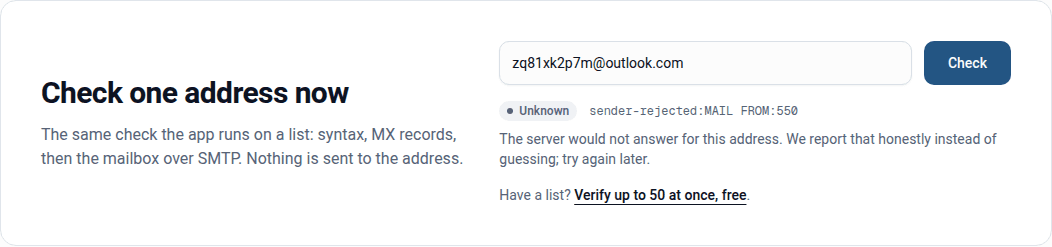
A tool that passes the second test on several made-up addresses is getting real answers. One that calls them valid is guessing. The same test works on us: paste a made-up Yahoo address into the free email verifier and you will get Unknown, which is the truthful result. Our comparison of email verification tools sticks to published prices and features for the same reason.
How do I check if a Yahoo email exists?
The reliable way to check if a Yahoo email exists is to use evidence from real mail: a confirmation click, recent engagement, or the bounce Yahoo returns to a small, careful send. Work through the list in this order.
- Pull the Yahoo and AOL rows into their own segment. Filter the verified CSV to Unknown and group by domain. If you are unsure whether a domain is run by Yahoo, look it up with the MX lookup tool; we observed hosts ending in
yahoodns.netfor yahoo.com and aol.com, and tested only those two. - Keep the addresses with recent engagement. A reply, a click or a purchase from that address is better evidence than any SMTP check. Opens are weaker evidence, as Apple Mail Privacy Protection explains.
- Keep the addresses that confirmed their opt-in. Yahoo's best practices page tells senders to "reduce the number of invalid recipients by using double/confirm opt-in". A confirmation click proves the mailbox existed on that day. See double opt-in vs single opt-in.
- Send to the rest in a small batch, after your Deliverable segment. Do it on a different day from the main send, so a bad batch cannot hide inside a good campaign.
- Read the bounces and suppress at once. Remove every address that returns Yahoo's "doesn't have an account" reply, shown below.
- Stop if the batch goes badly. Yahoo's error page lists "excessive unknown recipients" as a reason it rejects a sender. If many of the first batch bounce, the remaining unverified addresses are not worth the risk.
Bought or scraped Yahoo addresses with no engagement and no opt-in have nothing in their favour at step 2 or 3. For those, the honest advice is not to send. Yahoo's page says plainly: "Don't purchase mailing lists".
What bounce does Yahoo send for an address that does not exist?
Yahoo's bounce for an address that does not exist is a 554 reply that reads "delivery error: dd This user doesn't have a yahoo.com account". The sample on Yahoo's Sender Hub error page, as read on 13 November 2026, is:
Remote host said: 554 delivery error: dd This user doesn't have a yahoo.com account (testing123@yahoo.com) [-5] - mta123.mail.mud.yahoo.comUnder "Recipient does not exist" the same page says: "You should not retry delivery of the message. It will never complete successfully. You should remove the email address from your mailing list." Note that the code is a bare 554 with no 5.1.1, so a bounce rule that only matches 5.1.1 will miss it. In Yahoo's sample the line above the reply reads "failed after I sent the message", which suggests the rejection came after the message was transmitted, not at the recipient step. The sample is dated 2010, so treat that as a hint about Yahoo's behaviour, not proof of what it does today.
| Yahoo reply | Is it about the address? | What to do |
|---|---|---|
| 554 delivery error: dd This user doesn't have a yahoo.com account | Yes. Yahoo says the account does not exist. | Remove the address and do not retry. |
| 550 5.7.25 Forward-confirmed reverse DNS failed | No. The sending IP failed Yahoo's reverse DNS check. | Keep the address. Fix the PTR record of the sending IP. |
| 421 or 451, including "temporarily deferred" TS codes | No. Yahoo describes these as temporary problems. | Let your server retry later. Yahoo says you may retry 4xx errors. |
| 553 or 554 citing authentication, content or policy | No. The message or the sender was refused. | Keep the address. Fix authentication or the content, then send again. |
Other providers' wordings are in the email bounce codes guide.
Does Yahoo delete inactive email accounts?
Yahoo makes a mailbox inactive after 12 months without use, according to Yahoo's help page Inactive mailboxes in Yahoo Mail, and an inactive mailbox stops receiving new email. The page, as read on 13 November 2026, says: "If you don't access your Yahoo Mail mailbox for 12 months, it becomes inactive." It adds that signing in to the Yahoo account is not enough; the person has to open the mailbox. Stored messages, folders and contacts are permanently deleted.
Three details matter for senders:
- An inactive mailbox can come back. The owner can recover it by signing in again, so an address that bounces one season may accept mail the next. That is not a reason to keep mailing it.
- The whole account goes later. The US version of the page says an account with no sign-in for 18 months in total is scheduled for deactivation and deletion. Yahoo's regional pages do not all show the same period, so read the one for your region.
- Deleted IDs are not handed to new people. Yahoo's help page on reusing a deactivated Yahoo ID says: "We don't make deleted Yahoo IDs available to anyone else." Older articles describe Yahoo recycling usernames; that is not what Yahoo's page says as of November 2026.
Yahoo does not publish the reply a sender receives for an inactive mailbox, so we cannot tell you which code to expect. The practical conclusion is the same either way: a Yahoo address that has shown no activity for a year is a likely bounce, and verification will not warn you. An email sunset policy that retires long-inactive subscribers handles this better than any checker.
Is it worth verifying a list that is mostly Yahoo addresses?
Verifying a list that is mostly Yahoo addresses is worth less than verifying a business list, because the largest group will come back Unknown. It still removes malformed addresses, dead domains and disposable domains, and it gives clear answers for the Gmail and Microsoft 365 business addresses mixed in. Outlook.com and Hotmail behaved like Yahoo in our research and also come back Unknown.
If you want to see the split before deciding, the bulk email verifier is free for lists of up to 50 addresses with no card, and the CSV download shows the reason for every Unknown row. For Yahoo and AOL that reason will say the server rejected the sender. We would rather show you that than a green tick we cannot stand behind.
Frequently asked questions
Related reading
Ready to clean your email list?
Upload a CSV or XLSX and get every address marked deliverable, risky, undeliverable or unknown, with the reason. Free for lists of up to 50, no card. Nothing is sent to your contacts.