Mimecast Bounce Errors: 550, 451 and 554 Codes Explained
Mimecast is a cloud email security gateway: a filtering service that sits in front of a company's real mail system, so its servers are the ones that answer when you deliver to that company. That matters for reading the bounce. Most Mimecast rejections are decisions made by policies that the recipient's own IT team switched on, which means the fix is often on their side, not yours.
A note on sources before the codes. Mimecast documents its replies in a knowledge article on SMTP error codes, and its bounces link to it at community.mimecast.com/docs/DOC-1369. That link now redirects to Mimecast's support site, which could not be read on 13 November 2026 (it refused the request), and neither could the other Mimecast support articles we tried. So this post quotes only one Mimecast reply as fact: the one InboxSure captured itself. Every other reply string is marked typical wording, meaning the form senders commonly report, not text we confirmed on Mimecast's page. Match on the meaning, and open the link in your own bounce for the current text.
How do you read a Mimecast bounce?
Read a Mimecast bounce in two steps: the first digit of the code tells you whether to retry, and the words after it tell you which Mimecast check refused the message and therefore who can fix it.
The digits come from the SMTP standard, RFC 5321, not from Mimecast. A reply starting with 4 is temporary: RFC 5321 says the action "may be requested again". A reply starting with 5 is permanent, and the sender should not repeat the same request unchanged. The three codes you will meet most:
| Code | RFC 5321 definition | How gateways such as Mimecast use it |
|---|---|---|
451 | "Requested action aborted: local error in processing" | Any temporary refusal: greylisting, rate control, or a busy system. Retry later. |
550 | "Requested action not taken: mailbox unavailable", which the RFC extends to commands rejected for policy reasons | Both a missing recipient and a policy rejection. The words decide which. |
554 | "Transaction failed" | A permanent refusal of the message or the connection, usually on security grounds. |
Mimecast replies often carry no enhanced status code (the 5.1.1 or 5.7.1 part), so the text is all you have. The email bounce codes hub covers the general code families; this post covers what is particular to Mimecast.
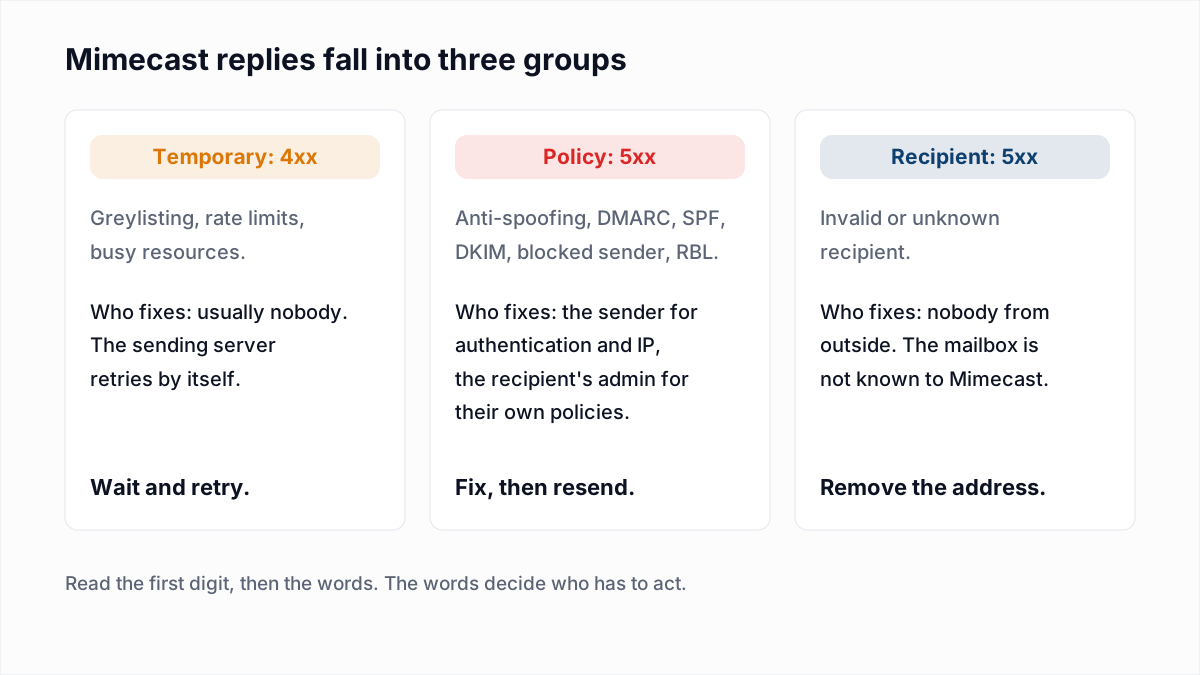
What does Mimecast's "451 Internal resources are temporarily unavailable" mean?
Mimecast's 451 "internal resources temporarily unavailable" reply is a temporary deferral: Mimecast would not process the request at that moment, the message stays in the sender's queue, and a normal mail server retries without anyone acting.
This is the one reply we can quote exactly. On 4 November 2026, during our research into how providers answer verification checks, InboxSure asked one of mimecast.com's own inbound servers about a random address. After fourteen seconds, at RCPT TO, it answered:
451 Internal resource temporarily unavailable - https://community.mimecast.com/docs/DOC-1369#451 [id]The wording differs slightly from the phrase people search for ("resource", not "resources are"), so match on meaning. The reply has no enhanced code and reads like an outage, but from a single reply an outside sender cannot tell an overloaded system from a deliberate slow-down of an unfamiliar connection. Both are a 4xx, and both get the same treatment: wait and retry.
It becomes a real problem only when it repeats for hours. RFC 5321 says a sending server should wait at least 30 minutes between retries and keep trying for at least 4 to 5 days, so one 451 costs you a delay, not a bounce. If every attempt over a day gets the same 451, the cause is more likely a rate or reputation control on your sending IP, and the recipient's Mimecast administrator can see which. Sender-side pacing is covered in email throttling.
How does Mimecast greylisting behave?
Mimecast greylisting behaves like standard greylisting as far as a sender can observe: a first attempt from an unfamiliar source gets a temporary 4xx reply, and a correctly behaving mail server that retries later is accepted.
We cannot give Mimecast's retry window or how long it remembers a sender, because its support site was unreadable on 13 November 2026 and we will not repeat second-hand numbers. What the standard says is public. RFC 6647, the greylisting specification, recommends keying on the sending IP, the envelope sender and the first recipient, and a default acceptance window of "from one minute to 24 hours". If you send to a Mimecast-protected domain and see a deferral:
- Leave the message in the queue. Do not treat a 4xx as a bounce and do not suppress the address.
- Retry from the same IP with the same envelope sender. RFC 6647 notes that a retry from a different IP can look like a brand-new sender.
- Do not hammer. Rapid retries do not shorten the wait.
- Escalate only if it never clears. A recipient's Mimecast administrator can exempt a known sender from greylisting. You cannot do that from outside.
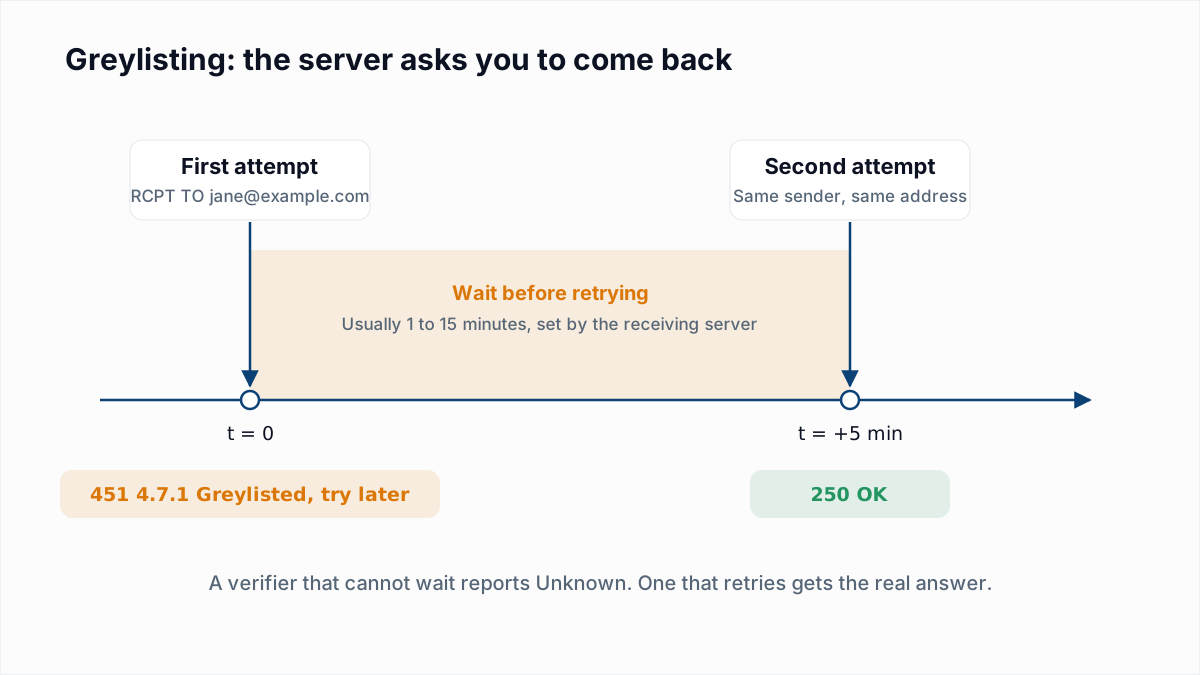
The mechanics and the windows used by other software are in greylisting explained.
What does "550 Rejected by header based Anti-Spoofing policy" mean?
"550 Rejected by header based Anti-Spoofing policy" (typical wording) means the recipient company's Mimecast account refused a message that came from outside but whose From header uses one of that company's own domains.
The policy exists to stop impersonation of colleagues. It also catches legitimate mail, and the pattern is nearly always the same: a third-party service sends on the company's behalf to the company's own staff. Think of a helpdesk, HR system, survey tool or newsletter platform sending as hr@example.com to people at example.com. From Mimecast's side that is external mail claiming to be internal.
Passing SPF and DKIM does not necessarily help, because the check is about where the mail entered, not whether it authenticated. The fix belongs to the recipient organisation: its Mimecast administrator adds an exception for that sending service. If you are the vendor, you cannot change the customer's policy; send their IT team the details listed further down, or send from a domain that is not theirs.
Which Mimecast policy rejections can the sender fix?
The sender can fix Mimecast policy rejections that are caused by the sender's own authentication or IP reputation: DMARC, SPF and DKIM failures, and a sending IP that is on a blocklist. Rejections caused by a customer's block entry are theirs to lift.
- DMARC, SPF or DKIM named in a 550. Your domain publishes a DMARC policy and the message failed it, or the gateway enforces authentication itself. Check the records with our SPF checker, DKIM checker and DMARC checker, then work through DMARC fail causes and fixes.
- A reputation or RBL policy named in a 550 or 554. The sending IP is on a blocklist the gateway consults. Run a blacklist check and follow how to check and remove a blacklist listing. For a Spamhaus hit, see Spamhaus blocklist removal. On a shared IP, your email platform has to act.
- A blocked sender or blocked envelope named in a 550. Someone at the recipient organisation, a user or an administrator, has blocked your address or domain. No DNS change fixes this. Only they can remove the entry.
If the reply is a 554 5.7.1 rather than a bare 554, the variants are sorted out in SMTP error 554 5.7.1.
What does Mimecast's "550 Invalid Recipient" mean?
"550 Invalid Recipient" (typical wording) means Mimecast does not recognise the address as a valid recipient at that company, so it refuses the message at the gateway before the company's mail server ever sees it.
Treat it as a hard bounce and suppress the address, the same as a 550 5.1.1. There is one exception worth a human check. A gateway only knows the recipients it has been told about, so a newly created mailbox or alias can be refused until the company's list of valid addresses reaches Mimecast. If the person insists the address is real, they should tell their IT team; nothing on the sending side changes the answer.
Who can fix each Mimecast error?
The sender can fix Mimecast errors caused by authentication, IP reputation, sending rate or a wrong address; the recipient organisation's Mimecast administrator is the only one who can fix errors caused by that organisation's policies.
| Reply (typical wording unless noted) | Who fixes it | Action |
|---|---|---|
451 Internal resource temporarily unavailable (captured by InboxSure, 4 November 2026) | Nobody, at first. The sending server retries. | Wait. Escalate to the recipient's admin only if it repeats for a day. |
| A 4xx naming greylisting, or a 4xx on first contact | The sending server, by retrying. | Retry from the same IP and envelope sender. Do not suppress the address. |
| A 4xx naming a rate or connection limit | The sender. | Send more slowly to that domain and let the queue drain. |
550 Rejected by header based Anti-Spoofing policy | The recipient's Mimecast administrator. | Ask them for an exception for your sending service, or stop sending as their domain. |
| A 550 naming DMARC, SPF or DKIM | The sender. | Fix the DNS records and alignment, then resend. |
| A 550 naming a blocked sender or blocked envelope | The recipient or their Mimecast administrator. | Ask your contact, by another channel, to remove the block. |
| A 550 or 554 naming a reputation or RBL policy | The sender, or the email platform that owns the IP. | Find the listing, fix the cause, request removal from the list. |
550 Invalid Recipient | Nobody from outside. | Remove the address. If the person says it exists, their IT team must add it. |
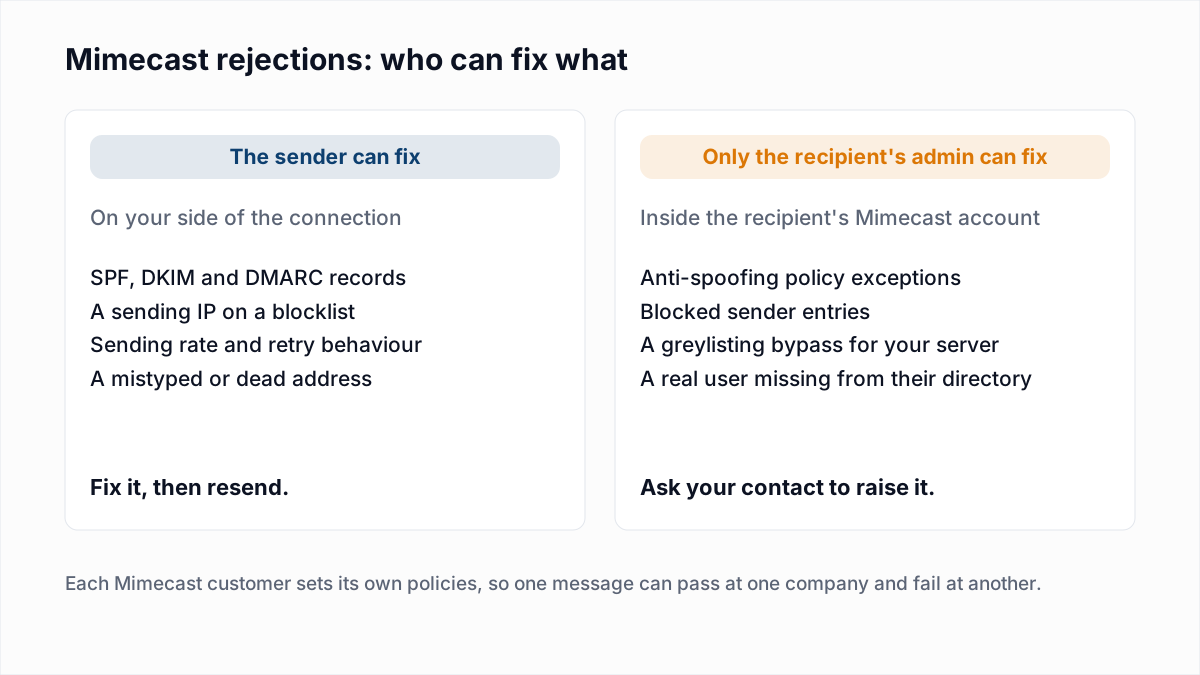
What to send the recipient's IT team
When the fix is theirs, make it easy. Send your contact, by phone or another mailbox:
- The full rejection text, including any ID in square brackets at the end.
- The date and time of the attempt, with the time zone.
- The From address, the envelope sender if different, and the recipient address.
- The IP address your mail left from.
Where to find them on your side is in how to read email headers.
Why does email verification return Unknown for Mimecast domains?
Email verification returns Unknown for a Mimecast domain when Mimecast answers the check with a temporary 4xx reply, because a 4xx says "ask later" and carries no information about whether the mailbox exists.
That is what our own test produced. The 451 above was the answer to a made-up address, and a real address would have had the same reply, so the only honest result is Unknown. InboxSure records it with the reason temporary-failure:451, which separates it from a block on the verifier itself, such as the one Proofpoint returned in the same test. Our test was one address on one day, so it does not prove every Mimecast customer answers this way: each customer configures its own policies.
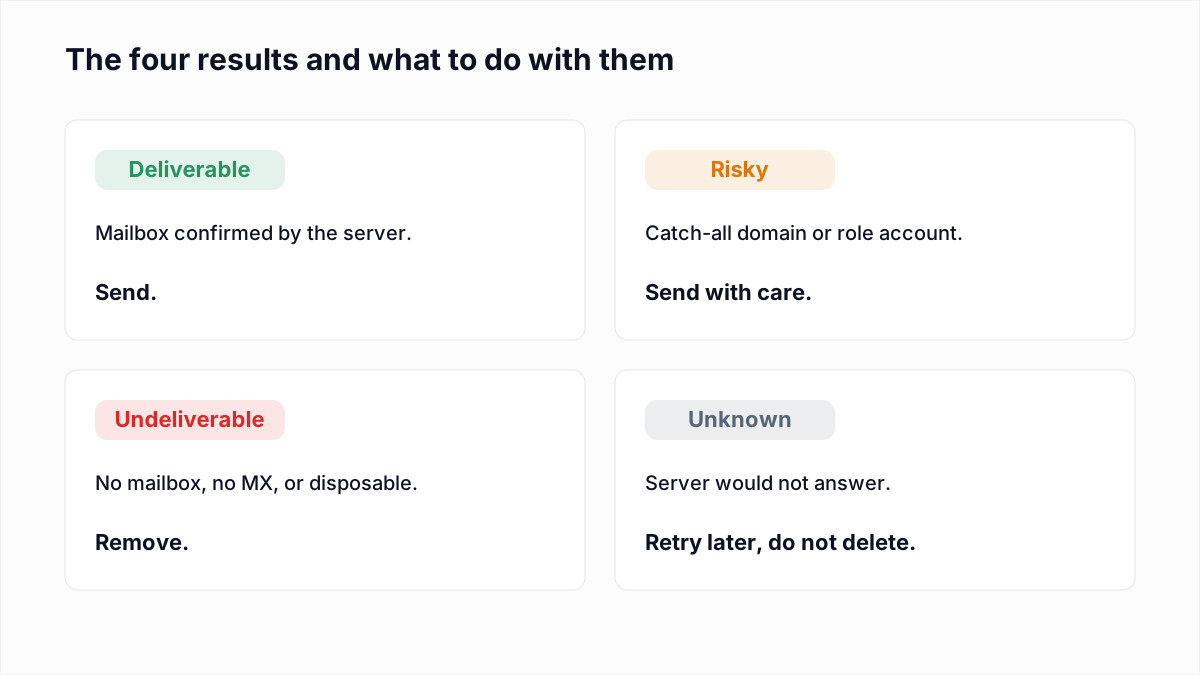
Unlike a sender rejection, a temporary failure is worth retrying. Re-verify the Unknown rows a day later. Whatever is still Unknown goes into a small test batch after your Deliverable segment. A verifier cannot wait out every gateway's window inside one job, and it cannot see policies such as anti-spoofing or a blocked-sender entry at all, because those apply to a real message and not to a mailbox check. A Deliverable result means the mailbox answered; it does not mean a gateway will accept your message.
The free email verifier shows the result and the reason for one address at a time. For a list, InboxSure verifies up to 50 addresses per list on the Free plan and up to 10,000 on Pro at $49 a month, and the CSV download includes the reason for every Unknown.
Frequently asked questions
Related reading
Ready to clean your email list?
Upload a CSV or XLSX and get every address marked deliverable, risky, undeliverable or unknown, with the reason. Free for lists of up to 50, no card. Nothing is sent to your contacts.