Should You Send Email From a Subdomain?
A sending subdomain is a name under your main domain, such as news.example.com, that is used in the From address, the DKIM signature and the Return-Path of one kind of email. The main domain, example.com, is what the DMARC standard calls the organizational domain: the name you registered. The one caveat to keep in mind from the start is that a subdomain separates mail streams from each other; it does not hide them from the parent. Mailbox providers can see that news.example.com belongs to example.com, and in several places Google says it counts them together.
Why send different kinds of email from different subdomains?
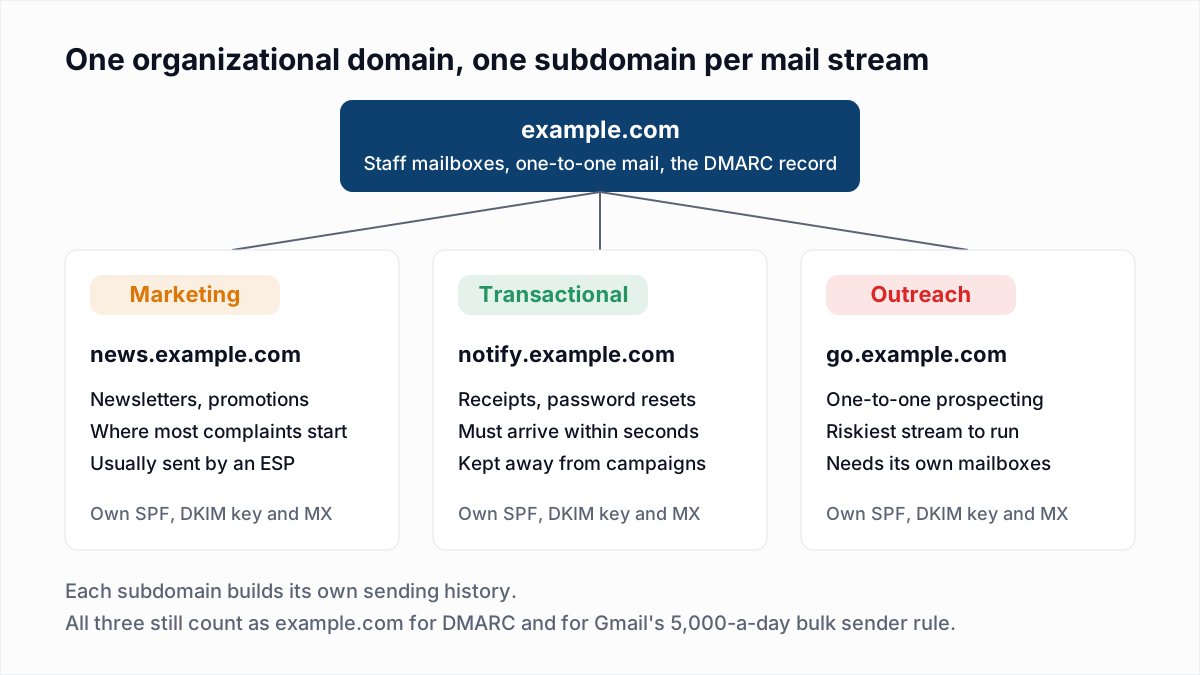
Sending each kind of email from its own subdomain lets every stream build a separate sending history, so a bad week for newsletters does not delay password resets or mail from staff mailboxes. The industry body M3AAWG says in its Sending Domains Best Common Practices (October 2019) that "receivers request (and may require) that different types of email traffic be separated when possible", and gives its main recommendation in one sentence: "It is strongly recommended that senders assign a separate subdomain of the main domain name for each distinct sending purpose."
The streams most senders separate are:
- Staff mail on the main domain: people writing to people.
- Transactional mail such as receipts and password resets, which recipients expect and rarely report.
- Marketing mail such as newsletters and promotions, where spam complaints are most likely.
- Outreach to people who have not heard from you before, the stream most likely to be reported or blocked.
There is a volume condition. M3AAWG adds that each segment needs "sufficient and relatively consistent traffic volume" to form a reputation, and that "for smaller volumes of email, it is acceptable to use different local parts of the sender address", meaning billing@ and news@ on one domain. A business that sends a few hundred messages a month gains nothing by splitting them across four subdomains.
Does subdomain reputation affect the root domain?
Subdomain reputation is tracked separately from the root domain but is not sealed off from it, and no major mailbox provider publishes how much carries over in either direction. What the primary sources do say, as of November 2026:
| Source | What it says | What it means for a subdomain |
|---|---|---|
| Google Postmaster Tools dashboards help | "The Domain Reputation dashboard only displays messages sent from the exact domain used for DKIM and SPF authentication." | Gmail keeps a rating for the subdomain itself. |
| Google Postmaster Tools dashboards help | The Compliance status dashboard "uses data from subdomains to determine compliance, but provides status for primary domains only." | Subdomain mail counts toward the primary domain's compliance. |
| Google email sender guidelines FAQ | "When we calculate the 5,000-message limit, we count all messages sent from the same primary domain." | Splitting volume across subdomains does not avoid bulk sender status. |
| M3AAWG Sending Domains BCP | "Proper use of subdomains will help your sending program benefit from the organizational domain's existing reputation." | Reputation flows from parent to subdomain, so the two are linked. |
Google's FAQ gives a worked example: a sender with 2,500 messages a day from solarmora.com and 2,500 from promotions.solarmora.com is a bulk sender, "because all 5,000 messages were sent from the same primary domain." We found no public statement from Microsoft or Yahoo on how they relate subdomain and parent-domain reputation. In short, a subdomain limits damage and makes problems easier to trace, and heavy abuse on a subdomain should be assumed to reach the parent. Google's reputation charts are also being retired, as described in our Google Postmaster Tools guide, so add each sending subdomain there and watch its spam rate.
What DNS records does a sending subdomain need?
A sending subdomain needs its own SPF record, its own DKIM key and an MX record; only the DMARC record can be left to the organizational domain. SPF and DKIM are looked up at the exact name used in the message, so nothing published at example.com covers news.example.com. For every record type in one place, see DNS records for email.
| Record | Where it is published | Inherited from the main domain? |
|---|---|---|
| SPF (TXT) | At the Return-Path domain, for example news.example.com or bounce.news.example.com | No. Each name needs its own record. |
| DKIM (TXT or CNAME) | At selector._domainkey.news.example.com, matching the d= value | No. Each signing domain needs its own key. |
| DMARC (TXT) | At _dmarc.example.com, or optionally at _dmarc.news.example.com | Yes. The organizational domain's record applies when the subdomain has none. |
| MX | At news.example.com | No. Without it, replies to the subdomain have nowhere to go (see no-reply email addresses). |
A finished zone for one marketing subdomain on an ESP looks like this:
news.example.com.                TXT    "v=spf1 include:_spf.esp-vendor.com ~all"
s1._domainkey.news.example.com.  CNAME  s1.domainkey.esp-vendor.com.
news.example.com.                MX 10  inbound.esp-vendor.com.
_dmarc.example.com.              TXT    "v=DMARC1; p=quarantine; sp=quarantine; rua=mailto:dmarc@example.com"
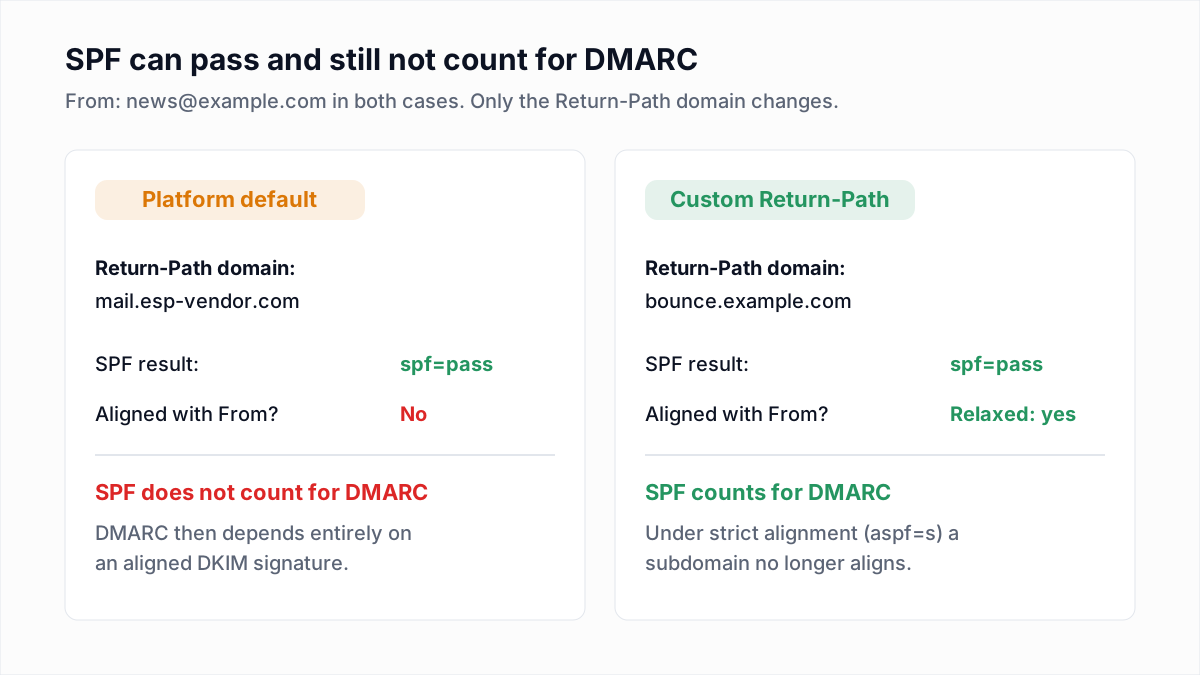
Three details cause most of the trouble. First, the SPF record belongs on whatever domain appears in the Return-Path, which your ESP may set to a further subdomain; our Return-Path guide shows how to find it. Second, DMARC alignment is relaxed by default, so a signature with d=example.com aligns with a From address at news.example.com, but for the subdomain to earn its own history the signature should use the subdomain. Third, the MX record. M3AAWG states that "domains used to send emails should have a proper MX record pointing to a functional email server", and that covers the Return-Path, From and Reply-To domains. Point the MX at your ESP's inbound host or at your normal mail host, and make sure a person reads what arrives.
Check the result with the SPF checker, entering the subdomain and not the root. An SPF record on the main domain that already has many includes is another reason to use subdomains: each name gets its own budget of ten DNS lookups, explained in SPF PermError.
Does a subdomain inherit the DMARC policy of the main domain?
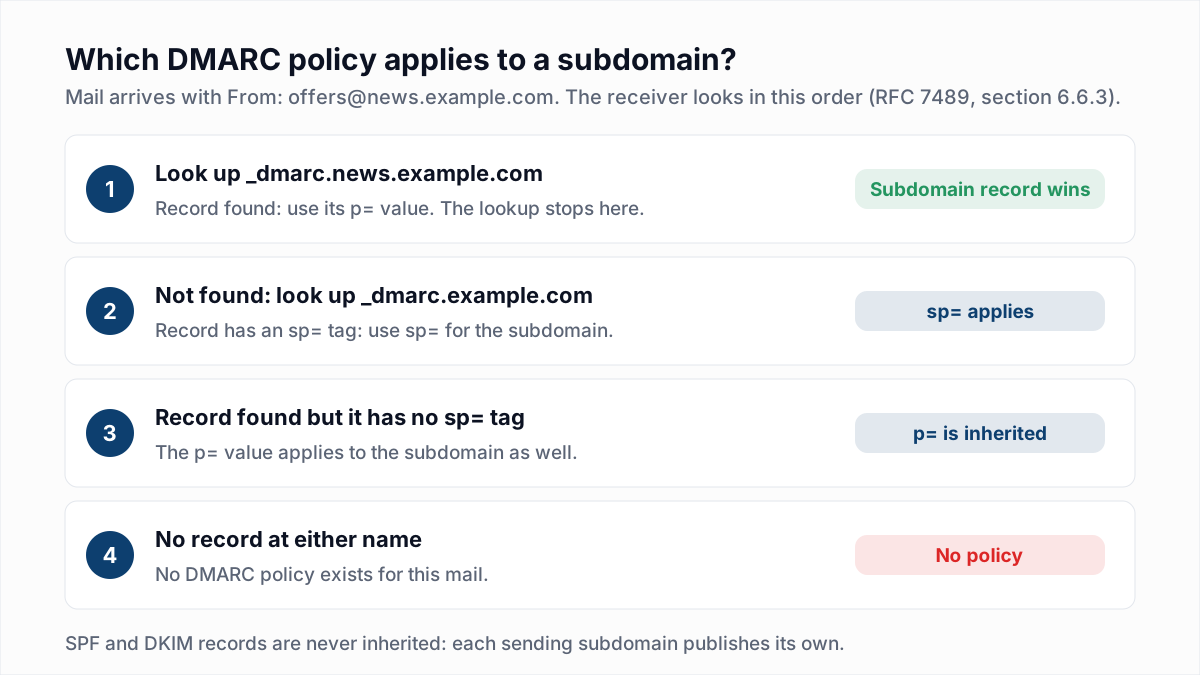
Yes, a subdomain with no DMARC record of its own is covered by the organizational domain's record, using the sp= tag if one is present and the p= tag if not. The lookup order is set out in RFC 7489, section 6.6.3: the receiver queries _dmarc at the From domain first, and if nothing is found it "MUST query the DNS for a DMARC TXT record at the DNS domain matching the Organizational Domain." Section 6.3 defines sp as the policy for subdomains and says: "It applies only to subdomains of the domain queried and not to the domain itself."
RFC 9989 replaced RFC 7489 in May 2026 (see what DMARC is) and changes two details here. First, receivers no longer rely on a public suffix list to find the organizational domain. Section 4.10 defines a "DNS Tree Walk": when the From domain has no DMARC record of its own, the receiver queries _dmarc at each parent name above it in turn, and the whole lookup never takes more than eight queries. The inheritance in the table below is unchanged: a subdomain covered by the organizational domain's record takes sp=, or p= when there is no sp=. Second, the new np= tag sets a separate policy for subdomains that do not exist in DNS (a query for the name returns NXDOMAIN). If np= is absent, sp= applies to them, and p= if there is no sp=.
| Record at _dmarc.example.com | Policy for example.com | Policy for news.example.com (no record of its own) |
|---|---|---|
v=DMARC1; p=reject | reject | reject, inherited from p= |
v=DMARC1; p=reject; sp=none | reject | none, so failing subdomain mail is still delivered |
v=DMARC1; p=none; sp=reject | none | reject |
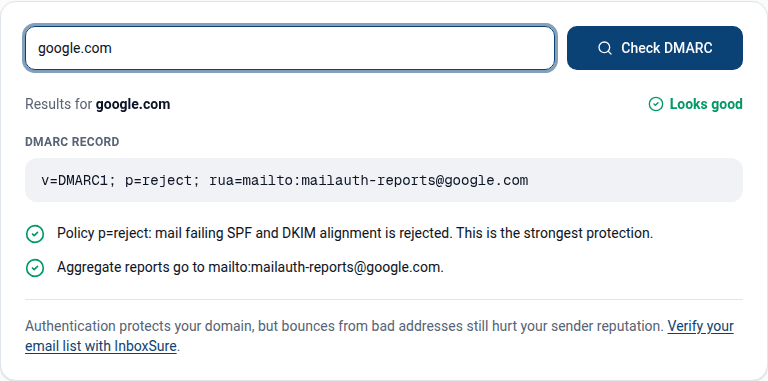
A record published at _dmarc.news.example.com overrides all of this for that one name. It is useful while a new stream is being set up: leave the parent at p=reject and give the new subdomain p=none with a reporting address until its reports are clean. Build either record with the DMARC generator and confirm what is live with the DMARC checker. The stages of tightening a policy are in DMARC policy: none, quarantine or reject.
Should you use a subdomain or a separate domain for cold email?
For cold email, a subdomain keeps the visible link to your brand and inherits its standing, while a separate lookalike domain isolates your main domain more fully but starts with no reputation and can look like phishing. Neither choice is free. M3AAWG calls the second option a cousin domain and is blunt about it: cousin domains "look like phishing campaigns to users and anti-abuse systems alike", and their use "is strongly discouraged by M3AAWG." That document was written for bulk and transactional senders, and many cold outreach teams still register secondary domains because the risk to the main domain is the one they most want to cap.
| Question | Subdomain (go.example.com) | Separate domain (example-team.com) |
|---|---|---|
| Is the main domain protected if outreach goes badly? | Partly. Providers can link the subdomain to its parent. | More fully by name, though links and content can still connect the two. |
| Does it start with any reputation? | M3AAWG says a subdomain benefits from the parent's existing reputation. | No. A new domain starts as unknown and needs a full warm-up. |
| How does it look to the recipient? | Clearly the same company. | Unfamiliar, and similar to how phishing domains look. |
| Does it count toward Gmail's 5,000-a-day bulk sender rule? | Yes, together with all other mail from the primary domain. | It is counted as its own primary domain. |
| What extra work is there? | DNS records and mailboxes on the subdomain. | A domain to buy and renew, its own DMARC record, mailboxes, and a website or redirect so the name resolves to something real. |
A reasonable rule: use a subdomain when the outreach is targeted, low in volume and something you would be content to see attributed to your brand. If you would only send it from a domain you are prepared to lose, the list or the message is the real problem, and no naming choice fixes that. Either way the mail leaves from mailboxes at Google Workspace or Microsoft 365, where you cannot choose the IP (see dedicated vs shared IP), and per-mailbox volumes stay as described in email sending limits.
What should you name an email subdomain?
Name an email subdomain after the kind of mail it sends, in one short word a recipient would recognise. M3AAWG's guidance is that "the subdomain name should be relevant to the type of email traffic sent", and its own examples are offers.mybrand.com for marketing and info.mybrand.com for transactional mail. For how the two streams differ, see transactional vs marketing email.
| Subdomain | Typical use | Note |
|---|---|---|
news. or offers. | Newsletters and promotions | Tells the recipient what to expect before the message is opened. |
notify. or updates. | Transactional and product notifications | Keep promotions off this name so it stays clean. |
billing. | Invoices and receipts | Worth separating if invoices are sent by a third-party billing tool. |
support. or help. | Helpdesk replies | Helpdesk platforms usually ask for their own DKIM and Return-Path records. |
mail. or email. | A single general sending subdomain | Fine for one stream; too vague when several streams share it. |
bounce. | Return-Path only, never the visible From | Receives bounces for the ESP; see the Return-Path guide. |
go. or hello. | Sales outreach | Our preference: a neutral name over sales. or outreach. |
How do you move a mail stream to a subdomain?
Moving a mail stream to a subdomain takes six steps, and DNS has to be right before the first message goes out.
- Pick the stream and the name. Start with the stream that causes the most complaints, usually marketing.
- Publish SPF, DKIM and MX for the subdomain using the values your ESP gives you, and confirm the organizational DMARC record's
sp=value will not reject the new mail while you test. - Send a test to a Gmail address and read the headers:
spf=pass,dkim=passanddmarc=passshould all name the subdomain or its parent. - Add the subdomain to Google Postmaster Tools. Google notes that once the primary domain is verified, its subdomains need no separate verification.
- Ramp up. A new subdomain is a new combination for receivers. M3AAWG suggests "6 weeks of warm-up as an average"; the schedule is in our email warm-up guide.
- Clean the list before the first send. Bounces in the first weeks land on a name with no history to absorb them.
For that last step, InboxSure checks each address for syntax, MX records and a live mailbox over SMTP without sending anything, and flags catch-all domains, role accounts and known disposable domains. It cannot tell you how a provider rates your subdomain, and Yahoo, AOL, Outlook.com and Hotmail addresses currently return Unknown because those providers refuse the check. What it does remove is the Undeliverable part of a list. The free plan takes lists of up to 50 addresses with no card, and Pro is a flat $49 a month for lists of up to 10,000: start with the bulk email verifier.
Frequently asked questions
Related reading
Ready to clean your email list?
Upload a CSV or XLSX and get every address marked deliverable, risky, undeliverable or unknown, with the reason. Free for lists of up to 50, no card. Nothing is sent to your contacts.